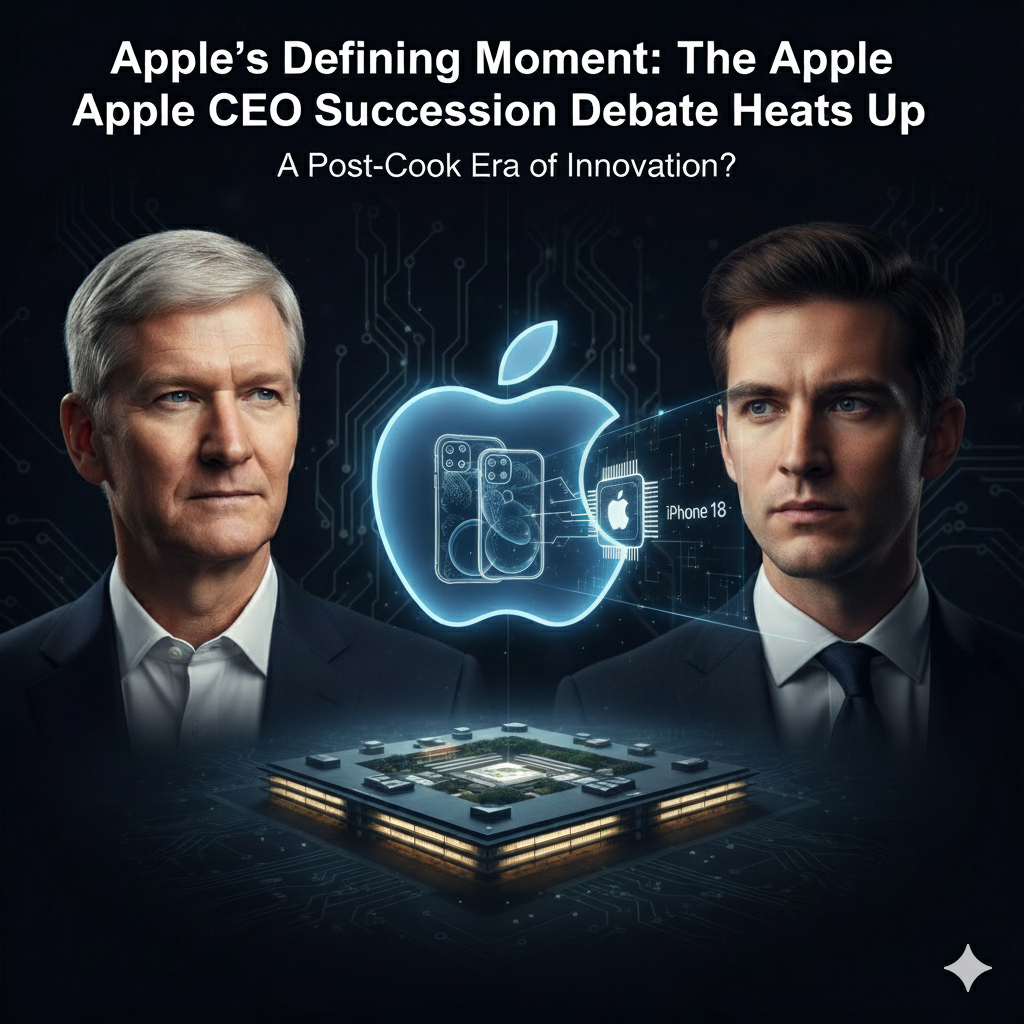
Apple is reportedly entering a new chapter – one that could reshape its future. In recent weeks, speculation has intensified that Tim Cook’s retirement in 2026 could be the beginning of a significant change. Sources reveal that Apple’s succession planning is now more active than ever. At the center of this story is John Ternus, Apple’s senior vice president of hardware engineering, who is widely considered a leading candidate to replace Tim Cook.
This potential Apple leadership change raises interesting questions: What will Apple look like in a post-Cook era? How might the iPhone 18 launch in 2026 reflect or impact this leadership change? And what does all this mean for Apple’s broader strategy?
A case for change: why succession at Apple is accelerating
1. Succession is no longer just a matter
Apple has long had succession plans, but insiders say the board and senior executives have recently “intensified” their efforts. yahoo finance According to reports, this is not just contingency planning – there is a real sense of urgency developing.
What is notable is that this is not being offered as a response to the company’s poor performance. By contrast, Apple is moving toward what analysts expect to be a strong holiday quarter for iPhone sales, suggesting that the pressure for change comes from long-term planning, not the crisis.
2. Timing matters: A 2026 start seems likely
Shortly after Apple’s earnings report in late January, multiple reports pointed to a possible announcement in early 2026. Times of India
That timing isn’t accidental – it’s strategic. By naming a new CEO early in the year, Apple will give the new leadership team time to settle in before major events: the annual developer conference (WWDC) in June and, importantly, the expected iPhone 18 launch event in September.
A smooth transition ahead of such high-risk events could be crucial to maintaining investor confidence and maintaining Apple’s innovation momentum.
Pioneer: John Ternus and the product-first vision of Apple
3. Who is John Ternus ?
If Apple chooses someone internally, John Ternus is the favorite. He has been with Apple since 2001, has overseen hardware engineering for major product lines (iPhone, iPad, Mac), and played a key role in Apple’s transition to its own silicon.
Turnus is more than just an engineer. According to Bloomberg’s Mark Gurman, Apple’s internal PR has begun to “turn the spotlight” on them in recent launches – a sign that Apple may be laying the groundwork for their eventual upgrade.
At 50, he is roughly the same age as Tim Cook when he became CEO in 2011.
Gurman also says that Turnus is not just technical; Their influence extends to product roadmaps, features, and high-level strategy.
This is potentially significant: Under a Turnus-led Apple, you can first see a real shift toward innovation — the post-Cook era that reignites the company’s design and product DNA.
4. Why might Turnus be the right choice?
Technical Reliability: With its deep hardware background, the Turnus embodies Apple’s engineering heritage. He probably understands the intricacies of the company’s most complex products.
Institutional memory: Having been with Apple for more than two decades, he knows the culture and values — but he also brings new energy.
Strategic vision: As someone who has influence over hardware decisions and long-term product roadmaps, he can lead Apple into its next innovation arena — especially at a time when the company faces increasing pressure in areas like AI and mixed reality.
Succession appeal: His internal profile helps Apple satisfy Cook’s preference for an internal successor. Cook has previously expressed that he values promoting from within.
iPhone 18 Factor: A launch that could define the future
One of the most interesting pieces of this puzzle is the iPhone 18 launch in 2026. Why does this event matter so much in the context of succession?
Symbolic milestone
iPhone 18 could serve as the first major product launch under the new leadership or closely associated with it. This may reflect not only a generational shift in hardware, but also a shift in philosophy. The Cook-era Apple relied heavily on operational efficiency, services, and financial discipline. A Turnus-led Apple could double down on hardware innovation, possibly with bold design changes, deeper integration of Apple Silicon, or a renewed focus on growth segments like AR/VR or AI-enabled devices.
Strategic setting
Apple’s reported plan to announce a new CEO ahead of the iPhone 18 event suggests the company wants change more than a behind-the-scenes shuffle — it wants a narrative. “This is the next era of Apple, built for tomorrow.” By pairing the Apple leadership change with a major product program, Apple can strengthen confidence among investors, developers, and consumers.
Investor confidence
From a financial perspective, a leadership change associated with a flagship launch sends a signal: Apple isn’t slowing down. It is willing to evolve, innovate and recommit to its roots. This helps allay fears that the company might become complacent or directionless after Cook.
Risks and Challenges: Is everything going smoothly?
Although the succession story has a compelling logic, it is not without potential pitfalls.
No final decision yet: According to multiple reports, no final decision has been made, despite strong speculation.
That means Apple could still move forward — either by delaying the transition, choosing a different successor, or even rethinking its strategy.
Pressure on Innovation: Apple has often been praised for its reliable, incremental product updates. But the next CEO will be evaluated on innovation – not just financial performance. If Turnus (or any successor) fails to deliver a compelling vision, the leadership change could disappoint markets expecting bold steps.
AI Weaknesses: One of the major criticisms leveled at Apple has been its relatively cautious AI strategy.
A new CEO will have to navigate Apple’s pivot to AI, especially when competitors like Google, Microsoft, and Amazon are already deeply entrenched in generative AI. If Apple doesn’t pick up the pace, it risks being left behind.
Execution Risk: Succession planning is easy to do on paper. But implementation is difficult. Apple will need to ensure continuity in operations and culture despite introducing a new face at the top. Poor execution can destabilize teams, slowing product development
What this means for investors, developers and consumers
For investors: This change could be a major turning point in Apple’s story. A strong internal successor like Turnus provides not only continuity, but also the potential for fresh energy. If Apple can provide a visionary product roadmap with a leadership reset, it could justify a new valuation narrative. On the other hand, delays in succession or missteps can spook the market.
For developers: Leadership changes often lead to changes in strategic priorities. If Apple leans more into hardware-based innovation, developers working on apps involving new form-factors (like future iPhones, AR devices, or AI-based services) could find new opportunities. A clear indication of innovation can also increase developer confidence ahead of future product launches.
For consumers: There’s real potential for excitement. Under a new leader, Apple could accelerate innovation in product categories it has long been speculated about — foldable devices, more powerful silicon, smart AI and mixed-reality gear. For longtime Apple users, this could be the beginning of a more adventurous phase for the company.
A reflection on legacy: the influence of Tim Cook
It’s worth pausing to consider the legacy of Tim Cook. Under his leadership, Apple’s valuation soared and the company matured into a global technology powerhouse. He drove efficiency, enhanced services, and created a culture that balanced profitability with ambition. But leadership change is inevitable – even for someone as iconic as Cook.
The potential change at the top underscores that Apple, at its core, has always been about innovation. By considering a hardware visionary like Turnus, Apple may be signaling a return to form — not necessarily a pivot away from Cook’s strengths, but an evolution that builds on them.
What comes next: Key milestones to watch out for To keep track of how this change occurs:
Apple’s Q1 earnings call (January 2026) without any mention of a leadership change or formal announcement.
WWDC conference (June 2026) – Can the new leader make public appearances or speak on stage?
iPhone 18 launch event (September 2026) – will this event mark the first major milestone of Apple’s new era?
Comments from Apple insiders, analysts, and media on Apple’s post-Cook strategy, particularly around AI, hardware, and product design.
Conclusion: An important moment for Apple
Apple stands at a potentially transformative moment in its history. Apple’s intensifying succession plans, the strong possibility of Tim Cook retiring in 2026, and the emergence of John Ternus as the potential next CEO all point to a carefully planned leadership transfer. With the iPhone 18 launching in 2026, this isn’t just a change at the top — it could be Apple’s attempt to re-establish its product-first identity and usher in a post-Cook era of innovation.
For investors, developers, and consumers, the stakes are high. If executed well, this could be the story that redefines Apple’s trajectory for the next decade.