
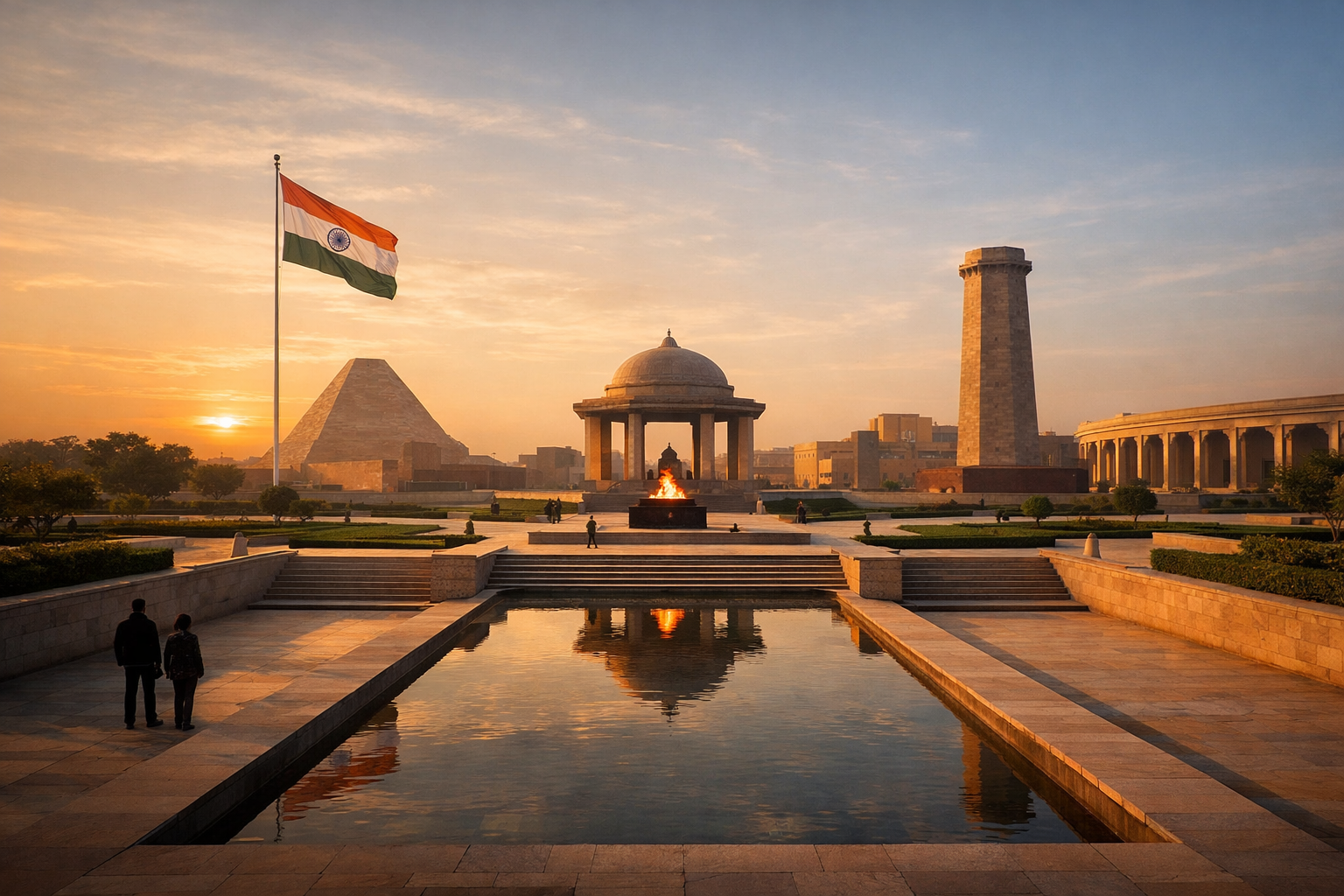
On December 25, already etched in India’s political memory, Narendra Modi inaugurated the Rashtra Prerna Sthal in Lucknow. Organized on the occasion of the birth anniversary of Atal Bihari Vajpayee, the event immediately attracted national attention.
At first glance, the inauguration may seem like another addition to India’s growing list of monuments. But when examined closely, the Nation of Inspiration site represents something much more layered. It reflects how India is reshaping the way it uses public spaces to preserve political legacy, communicate national values and influence future generations.
This NewsWell Insight explains what the Nation Inspiration site is, why it was created now and what it signals politically, culturally and strategically.
What is Rashtra Prerna Sthal?
Rashtra Prerna Sthal is a large national memorial and inspiration complex spread over approximately 65 acres in Lucknow. Designed as much more than a sculpture park, the site combines:
- Memorial places dedicated to national leaders
- Sculptural installation symbolizing political ideals
- Landscaped public area for reflection
- Museum-style structures explaining leadership philosophy
The emphasis is not only on remembrance, but also on interpretation – telling stories of leadership, governance and national vision in a systematic, institutionalized way.
Unlike older monuments, which focused primarily on individual statues, the Rashtra Prerna Sthal takes a modern narrative-driven approach, blending architecture, symbolism and public engagement.
Why does December 25th matter?
On the occasion of the birth anniversary of Atal Bihari Vajpayee, 25 December is celebrated as Good Governance Day at the national level. Vajpayee’s image as a consensus-builder, statesman and poet-statesman holds a unique place in Indian politics.
By inaugurating the memorial on this date, the government reinforced a deliberate connection:
- rule over personality cult
- institutions above individuals
- ideals above slogans
The timing transformed the event from a routine inauguration to a symbolic statement about continuity in leadership philosophy.
Why was Lucknow chosen?
Lucknow is not just the capital of Uttar Pradesh; It is deeply connected with Vajpayee’s political journey. The city has long been a center of political discussion, culture and administrative power in North India.
From a strategic perspective, Lucknow offers:
- geographical centrality
- political relevance
- historical echo
By locating the National Inspiration Site here, the memorial becomes accessible to a wider population while situating the national memory outside Delhi – a subtle but significant decentralization of symbolic power.
Changes in how India builds monuments
One of the most important aspects of the Rashtra Prerna Sthal is that it tells about the evolving memorial culture of India.
From sculptures to storytelling
Traditional monuments often focus on physical presence: statues, plaques and paintings. This new complex emphasizes:
- tell a relevant story
- conceptual framework
- academic interpretation
Visitors are expected to understand, not just see.
From faith to inspiration
The word inspiration is not accidental. The complex is designed to:
- encourage civic thinking
- highlight leadership values
- Inspire for public service
This signals a shift from monuments as passive spaces to active instruments of national messaging.
Political significance: beyond commemoration
While the memorial honors Vajpayee, it also serves a broader political purpose.
Reclaiming Narrative Space
In Indian politics, heritage is not only remembered but also contested. By institutionalizing Vajpayee’s legacy through the state-supported complex, the government strengthens its claim to a particular political lineage and governance philosophy.
Aligning past and present leadership
The inauguration by Narendra Modi creates a visible bridge between:
- Vajpayee-era governance ideals
- political vision of present times
This continuity matters, especially in an era where political legitimacy is increasingly tied to historical narratives.
Cultural impact and public memory
Public spaces shape the way society remembers. Rashtra Prerna Sthal contributes to the collective memory of India in three major ways:
- formalization of memory
Memory moves from personal recollection to institutional narrative.
- visual nationalism
Architecture and design become tools to reinforce national identity.
- intergenerational messaging
Young visitors encounter political history not through textbooks, but through an immersive environment.
Over time, such spaces influence the way leadership and governance are understood culturally.
Economic and urban implications
Large memorial complexes are not merely symbolic; They are also urban projects.
Tourism and local economy
The National Inspiration Site is likely to:
- increase domestic tourism
- Generate employment in services and maintenance
- Strengthen Lucknow’s position as a cultural destination
urban planning signs
The project is in line with broader trends of integrating cultural sites into urban expansion strategies, transforming symbolic infrastructure into economic catalysts.
Supporters versus critics: the ongoing debate
Like many large public projects, the National Inspiration Site has generated debate.
Proponents’ argument:
- National leaders deserve institutional remembrance
- Such places educate citizens
- Cultural infrastructure strengthens national identity
Critics’ question:
- cost vs public utility
- Priorities amid economic pressures
- Balance between memory and visualization
This debate is not new, but it reflects a larger question: how should modern nations invest in symbolic infrastructure?
Why does this monument matter now?
The timing of the inauguration of Rashtra Prerna Sthal is important.
- India is currently navigating:
- rapid economic change
- political polarization
Renewed emphasis on civilizational identity
At such moments, states often turn to symbols to reinforce cohesion and continuity. The Rashtra Prerna Sthal fits perfectly into this pattern – not as an isolated project, but as part of a broader effort to define how India sees itself and its leadership legacy.
The Newswell Insight: What comes next
From a NewsWell perspective, the Nation Inspiration site should be viewed as:
- A political sign, not just a monument
- A cultural institution, not just architecture
- A long-term narrative investment, not a short-term headline
Its real impact will be measured not in inaugural speeches or commencement appearances, but in how it shapes public understanding of leadership, governance and national values over the next decade.
As India continues to create physical spaces for memory, the Rashtra Prerna Sthal is a clear example of how monuments are evolving – from stone and bronze to stories, ideas and impact.
Frequently Asked Questions (FAQ)
Rashtra Prerna Sthal is a national memorial and inspiration complex built in Lucknow. It is designed to honor the legacy of Indian leaders and promote values such as leadership, governance and national service through architecture, exhibitions and public spaces.
This memorial was inaugurated by Narendra Modi on 25 December.
25 December is the birth anniversary of Atal Bihari Vajpayee and is celebrated as Good Governance Day across India. This date symbolically links the memorial to Vajpayee’s governance philosophy.
Read More : https://newswell.info/lvm3-m6-bluebird-block-2-isro-mission-analysis/