
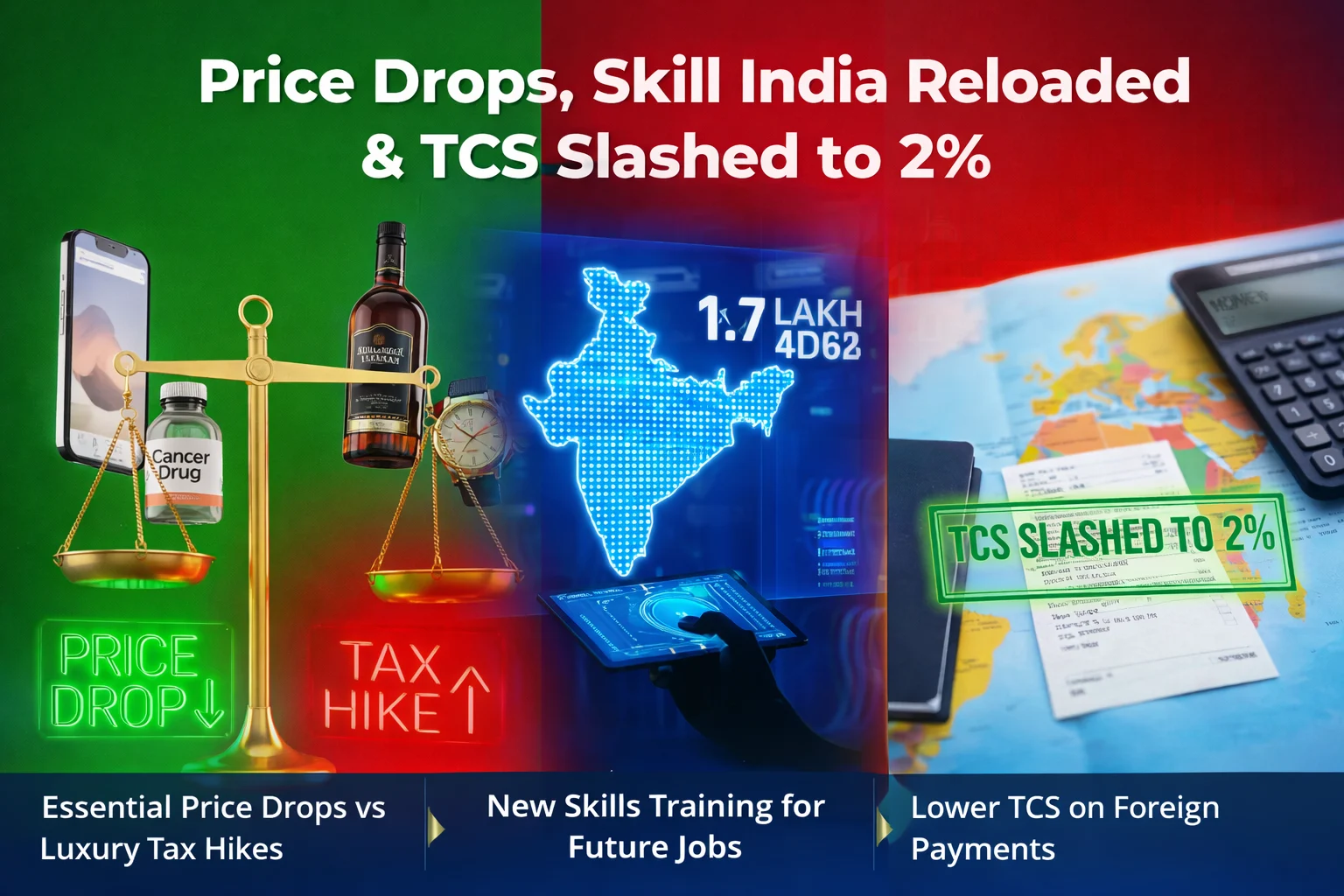
India is witnessing a period of rapid economic and policy-driven change. From selective price cuts on essential commodities to higher taxes on luxury goods, from the massive re-launch of Skill India to a massive 2% cut in tax collection at source (TCS), these developments are shaping the way citizens earn, spend, learn and invest.
Recent viral reels highlight three important stories that need more attention. Together, they explain how India is balancing welfare, growth and compliance in a rapidly growing economy.
Price declines versus tax increases: two sides of the same policy coin
At first glance, price drops and tax increases may seem contradictory. But in reality, they are part of a targeted economic strategy.
Why are some prices falling?
The government has reduced or rationalized prices on essential and socially important commodities, especially those that directly affect public welfare. These include:
- life saving drugs
- medical equipment
- Select Technology Products
- basic consumer needs
Low prices help reduce inflationary pressures and improve affordability for middle- and lower-income households. For many families, even a small reduction in the cost of health care or daily utilities can make a significant difference.
Why do luxury goods face tax increases?
On the other hand, taxes have increased on non-essential and luxury products such as:
- premium alcohol
- high end watches
- luxury electronics
- some imported goods
The logic is simple: discretionary spending should contribute more to public revenues. This approach ensures that government finances are strong without burdening essential consumption.
In short, the policy sends a clear signal – support requirements, tax indulgences.
Skill India Reloaded: Preparing the workforce for the future
One of the most impressive announcements featured in the reel is the relaunch of Skill India with a new focus, advanced technology and wider reach.
What’s new in Skill India Reloaded?
The revised mission aims to skill more than 1.7 lakh candidates in the current phase alone, with plans to expand it further. The new model emphasizes:
- Digital and AI-based learning tools
- Industry-aligned curriculum
- Certification with real employment value
Access to modern training infrastructure
Unlike earlier models, which focused primarily on traditional skills, the reloaded version targets future-ready roles:
- artificial intelligence and data
- cyber security
- Electronics and Semiconductors
- advanced manufacturing
- green energy
Why does it matter
India has one of the youngest populations in the world. However, employability does not depend on the degree alone, but on relevant skills. By linking training with real industry needs, Skill India Reloaded bridges the gap between education and employability.
For students, freelancers and job seekers, this initiative opens doors to high-demand, high-paying roles in India and globally.
TCS cut by 2%: Relief for individuals and businesses
Another major attraction of Reel is the reduction of tax collection at source (TCS) by up to 2% on specific transactions.
Understand TCS in simple words
TCS is a tax collected by sellers at the time of certain high-value transactions and deposited with the government. This often applies to:
- foreign remittance
- overseas education payment
- travel expenses
- some big shopping
Earlier, high TCS rates caused cash flow problems and compliance burden for individuals and small businesses.
- Impact of 2% cut
- Deductions provide several benefits:
- Better liquidity for taxpayers
- Reduce advance financial burden
- Easy compliance for businesses
Promotion of international education and travel
For students planning to study abroad or families sending money abroad, this change provides immediate financial relief.
For businesses, it reduces working capital strains and encourages seamless cross-border transactions.
The big picture: a balanced economic strategy
When seen together, these three developments reveal a broad policy direction.
1. People-centric governance
The price cuts on essential commodities and skills initiatives reflect a clear focus on citizen welfare and empowerment.
2. Revenue without additional burden
The luxury tax hike and structured TCS ensure revenue generation without hurting basic consumption.
3. India ready for the future
Skill India Reloaded reflects long-term thinking – preparing India not only for the jobs of today, but also for the economy of tomorrow.
How do these changes affect you directly?
Here’s what these policy changes mean for different groups:
- Middle class families: Lower costs on essentials, better access to skills
- Students: Affordable overseas education payments and future-ready training
- Pros: Better skill opportunities, less friction
- Business: Better cash flow and clear compliance
- Economy: High productivity, controlled inflation, sustainable growth
Conclusion: Improve with direction, not disruption
India’s economic reforms are focusing on precision rather than broad policies. By selectively reducing prices, taxing luxury consumption, investing in skill development and simplifying the tax collection mechanism, the government is attempting to strike a delicate balance.
The message is clear:
- Support what matters
- Provide skills to youth
- Simplify taxation
- Encourage responsible spending
As these reforms take effect, their real success will depend on implementation and access. But one thing is certain – India is moving towards a more targeted, inclusive and future-oriented development model.
The government is reducing prices on essential goods like medicines to control inflation, while increasing taxes on luxury goods to raise revenue without burdening common citizens.
The price cuts mainly apply to essential goods like life-saving drugs, medical devices and select consumer goods that directly impact public welfare.
Luxury goods such as premium alcohol, imported watches, and high-end electronics are taxed more to promote fair taxation and discourage unnecessary imports.
Skill India Reloaded is an upgraded version of the Skill India Mission that focuses on advanced skills such as AI, digital technology, manufacturing and future-ready employment.
In the current phase, more than 1.7 lakh individuals are expected to receive skill training, with further expansion planned across India.