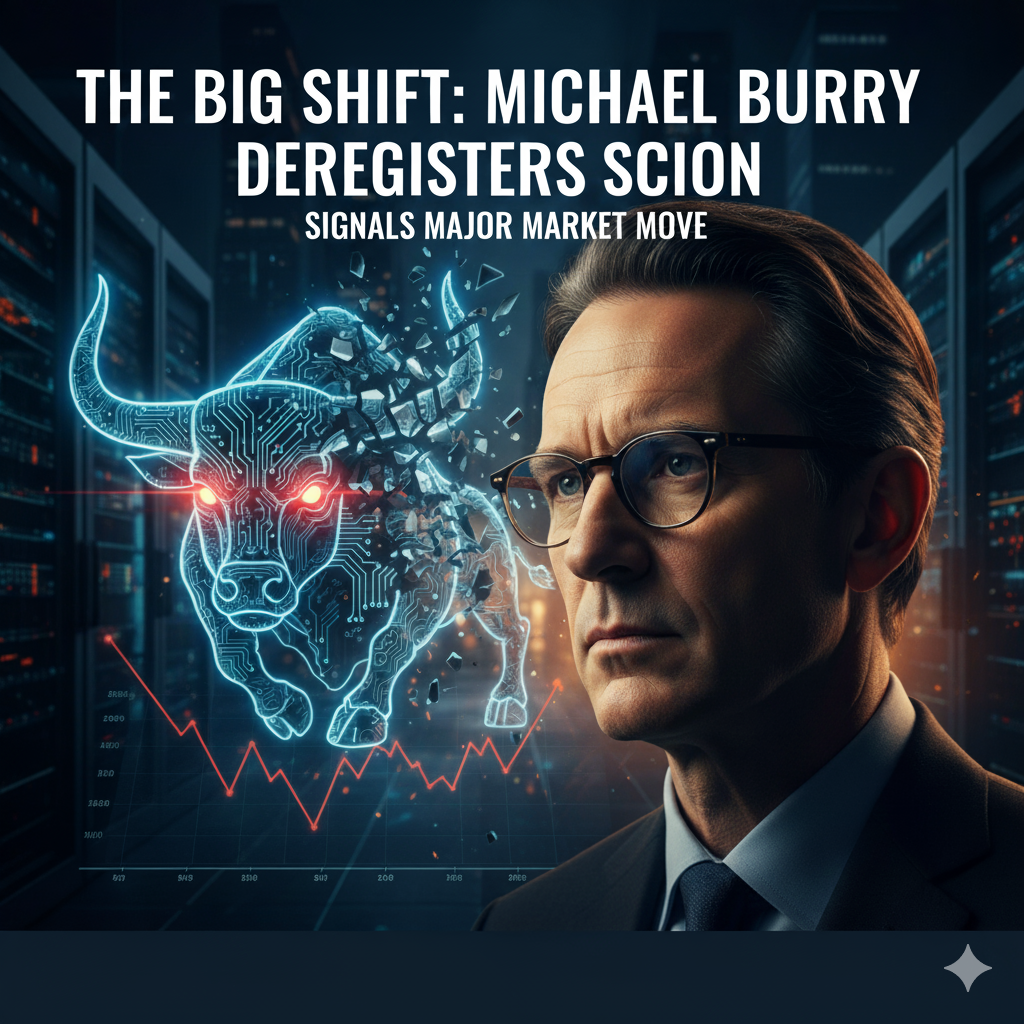
When an investor of Michael Burry caliber makes a big cut, the market listens. Known for his prescient timing, the man who foresaw the housing crash now appears to be signaling another pivot. This time, it’s not just a trade, but a structural change: Scion Asset Management deregistration.
In early November 2025, the US Securities and Exchange Commission (SEC) database registered that Scion had terminated its registration as an investment adviser, meaning it is no longer required to file similar public disclosures. – reuters As of March 2025, the firm managed approximately $155 million – reuters
What really happened
Barry posted a screenshot showing the finished state of the scone on his social-media account (X:formerly Twitter). In that post he declared: “Much better things will happen on November 25th.” business insider. The termination took effect Nov. 10, according to the filing.
In fact, they have eliminated external capital management, at least in the structure of a registered hedge fund, and appear ready to transition to the private family-office model or some other form of investment.
Why does it matter
Hedge fund deregistration, what does it mean when a hedge fund gets deregistered, michael bury new investment strategy 2025, you’ll see why this step is important: When a fund deregisters, it typically means fewer regulatory filings, less forced disclosure of holdings, and more freedom in how to use capital. This profoundly changes how the market may interpret Barry’s actions going forward.
Background: Bury’s heritage
Let us remind ourselves: Bury came into the public spotlight for his role in predicting the US housing market meltdown, as described in the book and film The Big Short. He started by managing Scion Capital which later became Scion Asset Management. Wikipedia Their model has always been value-oriented, contrarian, searching for mispriced assets and sometimes fighting consensus.
So when someone like him makes a change in the structure – by canceling the registration of the firm – it is not just administrative. This indicates that it wants a different operating platform. In his words: “My estimation of value in securities is not in line with the markets now and for some time.”
Their recent moves and market signals
Michael Burry’s short position in the AI bubble, Michael Burry bets against AI stock Nvidia Palantir, Implications of Michael Burry deregistering Scion Asset Management.
In a recent filing, Scion revealed that it has acquired bearish put options against leading AI-powered stocks like NVDA (NVIDIA) and PLTR (PALANTIR).- business insider
Bury’s argument: The boom in AI investment has pushed valuations into frothy territory, and companies are using aggressive accounting (particularly around the depreciation of hardware) to hide the true cost of their investments.
One article states that these AI-focused stocks have accounted for about 75% of the S&P 500’s gains since the end of 2022.
What does it mean? When someone with their track record talks about what it means for a hedge fund to be unregistered, it raises questions:
- Is he moving from managing other people’s money to managing only his own money?
- Is he looking for a different kind of investment vehicle altogether?
- And is their move against AI stocks a sign of an impending correction or a bubble?
Broader market context
In a market where growth-stocks, tech giants, and AI companies are in the headlines, the AI stocks, market bubble, and short selling are highly relevant. Barry’s actions suggest that he may believe we are entering one of those inflection points where the consensus is wrong.
His criticism of companies like Nvidia, Palantir, MSFT (Microsoft) and GOOGL (Google) focuses on how they are investing billions in AI hardware and infrastructure, but potentially increasing depreciation schedules to smooth out profits – in Barry’s view, a sign that the party may be over.
For investors reading this blog, think of it this way: One of the more important signals in the current market is not just the price of Nvidia or Palantir, but a change in the way someone like Barry is choosing to participate (or not) in the outside money management game.
What to watch (and why)
If you’re following or working in the investment sector, particularly focusing on crypto, public markets, hedge funds or even content creation around the markets, there are several dimensions to keep an eye on:
Launch of the new structure: He teased the launch date of November 25th. It may represent a new vehicle, or a new type of engagement, Michael Bury new investment strategy 2025.
Portfolio Disclosure: With deregistration comes less required filings. What he keeps (or doesn’t keep) may be less visible – which is itself a strategic signal.
Markets are reacting to bets: Their put-options against AI stocks send a strong message about their view of the bubble. If those areas falter, it reinforces their thesis; If not, it raises questions.
Media Narrative and Investor Sentiment: Michael Burry’s Short Position in the AI Bubble Michael Burry bets against AI stock Nvidia Palantir, using this to indicate how many people will interpret his actions as an early warning of trouble.
Implications for broader investing themes: If Barry is moving away from the traditional hedge-fund model, what does it say for the broader direction of institutional money? Are we moving from “other people’s money” to private strategies?
Why should Newswell readers care?
At Newswell, our audience includes intelligent investors, market watchers, bloggers, creators and more. The story of Bury’s deregistration is more than a typical hedge-fund move – it coincides with the major investing themes of our era:
The dominance of AI stocks and whether it is a bubble or the future of the market.
Changes in the way investment capital is organized, especially after years of cheap money and high valuations.
The broader question: When one of the most contrarian investors in history says, “I’m stepping aside,” what should we infer about today’s market context?
What could happen next
Let’s look at some possible scenarios:
Scenario A: Barry’s new vehicle launches aggressively and deploys capital
On November 25 he unveiled a new investment vehicle, perhaps a family-office style fund or something more specialized. We may see the emergence of alternative assets (water, agricultural land, gold), as they have historically done.
Scenario B: Their bets were successful and we see a market correction in AI stocks If the put positions against Nvidia, Palantir materialize, the story of a market bubble and AI stocks being overvalued will gain momentum. His move will be seen as prophetic.
Scenario C: He remains calm and the market remains bullish
If the rally continues, his move may seem untimely. Analysts may ask: Is he stepping away for personal reasons, or because he sees something the market doesn’t?
Scenario D: A hybrid – that signals a change in investment mindset
Regardless of the returns, the broader conclusion might be this: The hedge-fund model is evolving. Outside capital-heavy hedge funds may become less effective, while private capital or strategic strategies become dominant. In that case, the Michael Burry deregistering Scion Asset Management will be reflected in many analyses.
Tips for Investors and Content Creators
For investors: Don’t just look at what Bury has to offer; See how he catches it and why he is changing the formation. That psychological/structural signal may matter more than the exact ticker.
For those following market sentiment: A great rival changing its mode is a potential sentiment indicator. Maybe it’s not about him being wrong or right – it’s about him saying “the game has changed.”
For the crypto-centric world (since you’re in that area): Although this story is about stocks and hedge funds, the topics of capital structure, bubbles, alternative assets, and changing investment models are highly relevant. The idea of “when external clients’ money becomes a burden” or “moving towards own capital” can also be translated into crypto-asset fund and operator models.
Last words
Michael Burry deregistered his hedge fund, Scion Asset Management. But the deeper story is about change – change in how investing is done, change in how capital is managed, and change in how we interpret market risk.
In an era where AI dominates stock returns, where valuations seem high, and where optimism is thick, Bury’s move feels like a whispered warning. Whether this becomes a loud alarm or just a footnote will depend on how the market and its new strategy evolve.
At Newswell, we’ll be following this story – analyzing their next move, analyzing how their new structure behaves, and looking at what it signals about the broader market. Because sometimes the most meaningful market signals are not in what someone says, but in how they choose to participate.