India’s aviation sector is once again facing turmoil, and this time the center of the storm is Indigo Airlines, the country’s largest carrier by market share. For the past several days, passengers in major metros – Delhi, Mumbai, Bengaluru, Hyderabad, Chennai, Kolkata – have been stranded as IndiGo flights have faced huge delays, mass cancellations and operational disruptions.
Searches on Google like “IndiGo flights,” “IndiGo crisis,” “IndiGo delay,” “IndiGo flight canceled today,” “IndiGo pilot shortage crisis,” and “Why are IndiGo flights getting canceled today” have skyrocketed, indicating the scale of public concern.
But what exactly caused this aviation failure? Why is India’s most trusted airline suddenly struggling? And what does this crisis mean for the Indian economy, aviation industry and financial markets?
This in-depth report, backed by NewsWell expert analysis, breaks down every layer of the issue – from on-ground passenger impact to macro-level financial implications.
What is the reason for Indigo crisis?
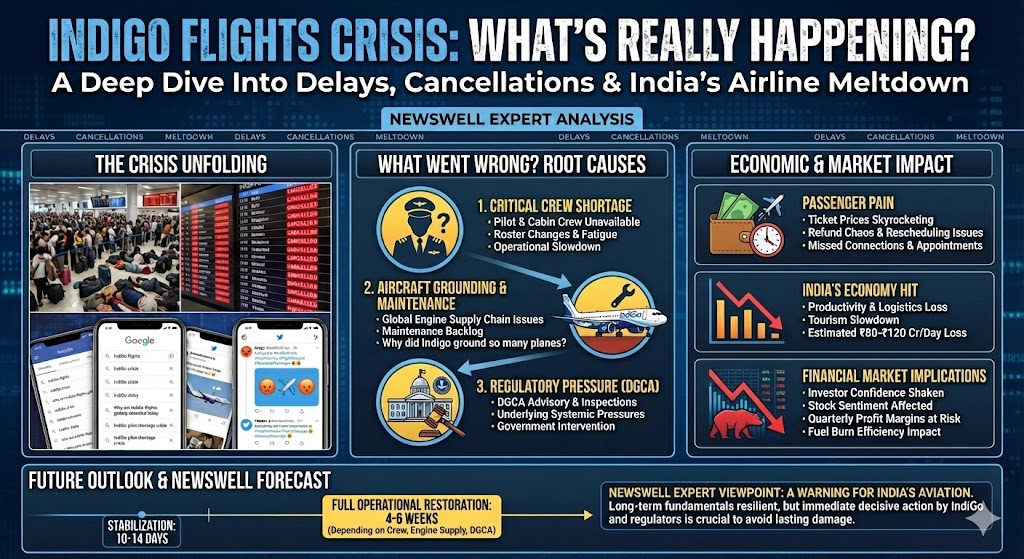
According to several industry indicators, the crisis is being generated by a combination of factors:
1. Critical pilot and crew shortage
Long distance schedules, increased workload and sudden roster changes have led to crew unavailability, leading to the following situations:
- Indigo flights delayed due to pilot shortage
- IndiGo’s operational slowdown
- Cancellation is happening due to Indigo staff problem
Questions from passengers like “Is IndiGo on strike today?” And the “real reason behind IndiGo crew shortage” has surfaced online.
2. Aircraft grounding and maintenance backlog
IndiGo’s Airbus A320neo fleet has been affected by delays in the global engine supply chain, due to which:
Why did Indigo ground so many planes?
Indigo operations affected due to ongoing maintenance
3. DGCA inspection and regulatory pressure
Aviation regulator DGCA has stepped in with an advisory, prompting searches:
- DGCA update on Indigo flight cancellation
- DGCA action on Indigo
- indigo crisis latest update
Regulatory attention often signals underlying systemic pressures.
Passenger impact: chaotic terminals and frustration everywhere
Common high-intent search queries reveal the problem:
- How to get refund from IndiGo for canceled flight
- Will IndiGo refund full amount for flight delay?
- How to reschedule IndiGo flight for free
- IndiGo Refund Policy for Canceled Flights
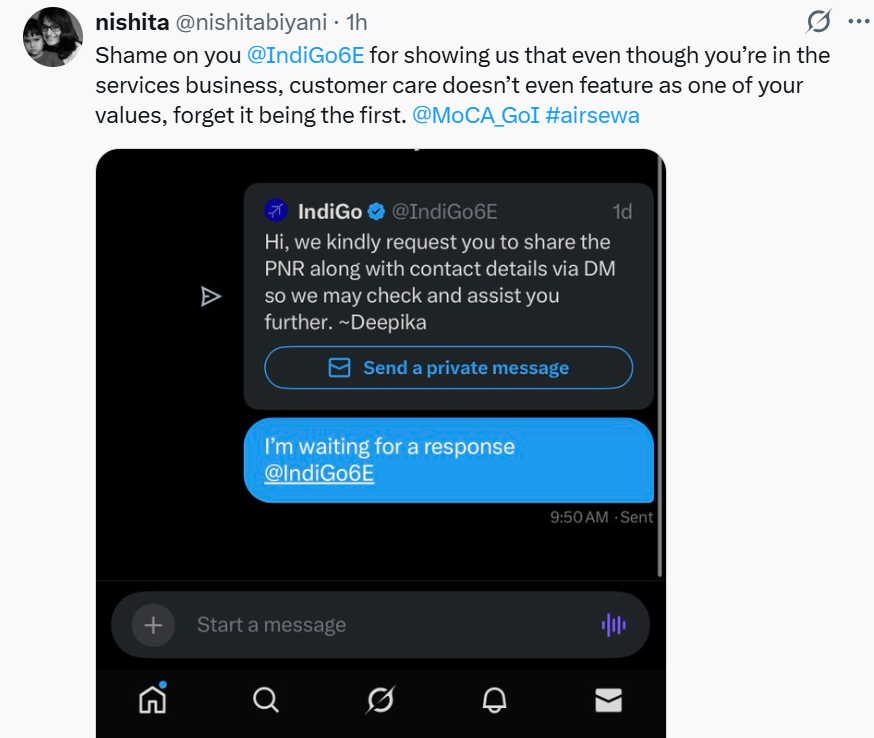
- Indigo customer support is not responding
Airports seen:
- long queues
- I wait all night
- Passengers are not getting international connections
- business travelers are missing meetings
- Students and patients are missing out on time-sensitive appointments
- Social media is filled with real stories of IndiGo flight cancellations, increasing public anger.
Why are Indigo flights getting canceled today?
Short answer: crew shortage + grounded aircraft + operational misalignment.
Long answer: Many internal and external factors align at the worst moment.
Most airlines may face one or two disruptions.
Indigo is currently facing four at the same time, creating a domino effect.
Breaking down economics: Newswell insights and expert analysis
The current IndiGo crisis is not just an airline problem.
This has three major economic impacts:
1. Air travel demand versus supply shock
India has seen unprecedented demand growth in domestic travel – growing at around 18-21% year on year.
When the largest airline suddenly reduces operating capacity:
- Air ticket prices are skyrocketing
- business travel becomes expensive
- tourism slowed down
Searches like “How does the IndiGo crisis affect ticket prices” clearly reflect public concern.
Newswell Insight:
Supply contraction in a high demand environment always leads to inflationary pressure.
In this case, airfare inflation is likely to reach 8-12% in the next 30-45 days.
2. Impact on India’s economy and productivity
Flight disturbances directly affect:
- corporate productivity
- logistics planning
- tourism revenue
- Startups and tech sector dynamics
- SME supply chain timelines
When the disruption is at its peak, aviation delays cost India an estimated ₹80-₹120 crore per day in lost economic output.
Newswell Expert Viewpoint:
IndiGo handles 60% of India’s domestic passenger volume on some routes.
Any recession on this scale directly impacts GDP-linked mobility metrics such as business travel hours, interstate trade movement and tourism flows.
3. Financial Market Implications and Investor Reactions
While IndiGo’s parent company remains fundamentally strong, temporary crises impact:
- Stock sentiment
- Institutional investor confidence
- Quarterly profit margins
- Fuel burn efficiency due to unscheduled operations
As cancellations increase, the cost per available seat (CASK) increases, impacting profitability.
Newswell Expert Analysis:
IndiGo may take a short-term financial hit, but the long-term fundamentals of the airline remain resilient.
However, if the crew shortage crisis persists for more than 4-6 weeks, it could impact Q4FY20 earnings, thereby impacting share price volatility.
Why this crisis is more important than previous disruptions
India’s aviation ecosystem is already fragile:
- go first collapsed
- SpiceJet is in financial stress
- Air India is still restructuring
- Indigo was the stable backbone.
Now, its crisis highlights the extreme dependence of Indian air travel on a single airline.
Searches like “Is IndiGo safe to fly after the crisis” and “Future of IndiGo after the crisis” reflect deep consumer concern.
Root-Cause Insight: A rare analysis of the real issues
1. Excessive market share
Being too big becomes harmful during a disruption.
IndiGo cannot reassign aircraft as easily as smaller airlines.
2. Crew Scheduling Overload
Reports indicate that pressure on crew duty cycles is increasing.
Low-cost airlines operate on thin margins, making flexibility difficult.
3. Engine Supply Chain Failure
Global Pratt & Whitney delays affect many airlines.
4. Congested airports of India
Even minor operational glitches increase during peak hours.
Traveler Guide: What You Should Do Now
If your flight was cancelled:
- Apply for Refund → Check IndiGo Cancellation Refund Status
- claim alternative flight
- Reserve boarding pass for compensation
If your flight is delayed:
Check if the delay is more than 3 hours → You may qualify for rescheduling or refund
Document everything (photos, delayed screenshots)
Safety Tip:
Avoid tight relationships for the next 2-3 weeks.
Will the crisis end soon?
Trending questions like “When will IndiGo operations return to normal?” and “How long will the Indigo crisis continue?” Reflect the growing urgency.
Newswell Forecast:
- Stabilization is expected in 10-14 days, depending on:
- Crew Availability Normalization
- engine supply clarity
- DGCA’s intervention
- Full operational restoration may take 4-6 weeks.
Public sentiment and market mood
- Social platforms show:
- passengers’ anger
- humor through memes
- fear of flying
- Criticism of airline management
- Praise for the ground staff who dealt with the chaos
Economic forums are debating:
- Does India need more airlines?
- Is domestic aviation oversaturated?
- If the price range should be reconsidered
How this crisis will reshape India’s aviation future
1. Strive for more competition
Having a single airline hold a large market share is risky.
2. Better workforce policies
Crew fatigue management can be stringent.
3. Aviation reforms at government level
- DGCA will tighten strictness:
- slot management
- Roster Audit
- ground time compliance
4. Investment Shift
Airline stocks may see volatility, which favors investors who understand cyclical industries.
Conclusion: A warning for India’s sky-rocketing economy
The IndiGo flight crisis is not just an operational disruption – it is a moment that highlights the fragility of India’s fast-growing aviation ecosystem.
- The passengers are disappointed.
- Airports are overwhelmed.
- The economy is feeling the shocks.
- And financial markets are watching closely.
Yet, as NewsWell expert insights highlight, long-term damage can be avoided – if IndiGo and aviation regulators act decisively.