
When India’s T20 World Cup squad was announced, the immediate reaction on social media was predictable – shock, outrage, celebration and speculation all in one. Big names were debated, gaffes were questioned and an immediate battle of opinions broke out on leadership choices.
But beyond the noise there is a more important story.
This team announcement is not just about who made the cut and who did not. It is about how India views T20 cricket now, what the selectors are prioritising, and what kind of team India wants to be in global tournaments going forward.
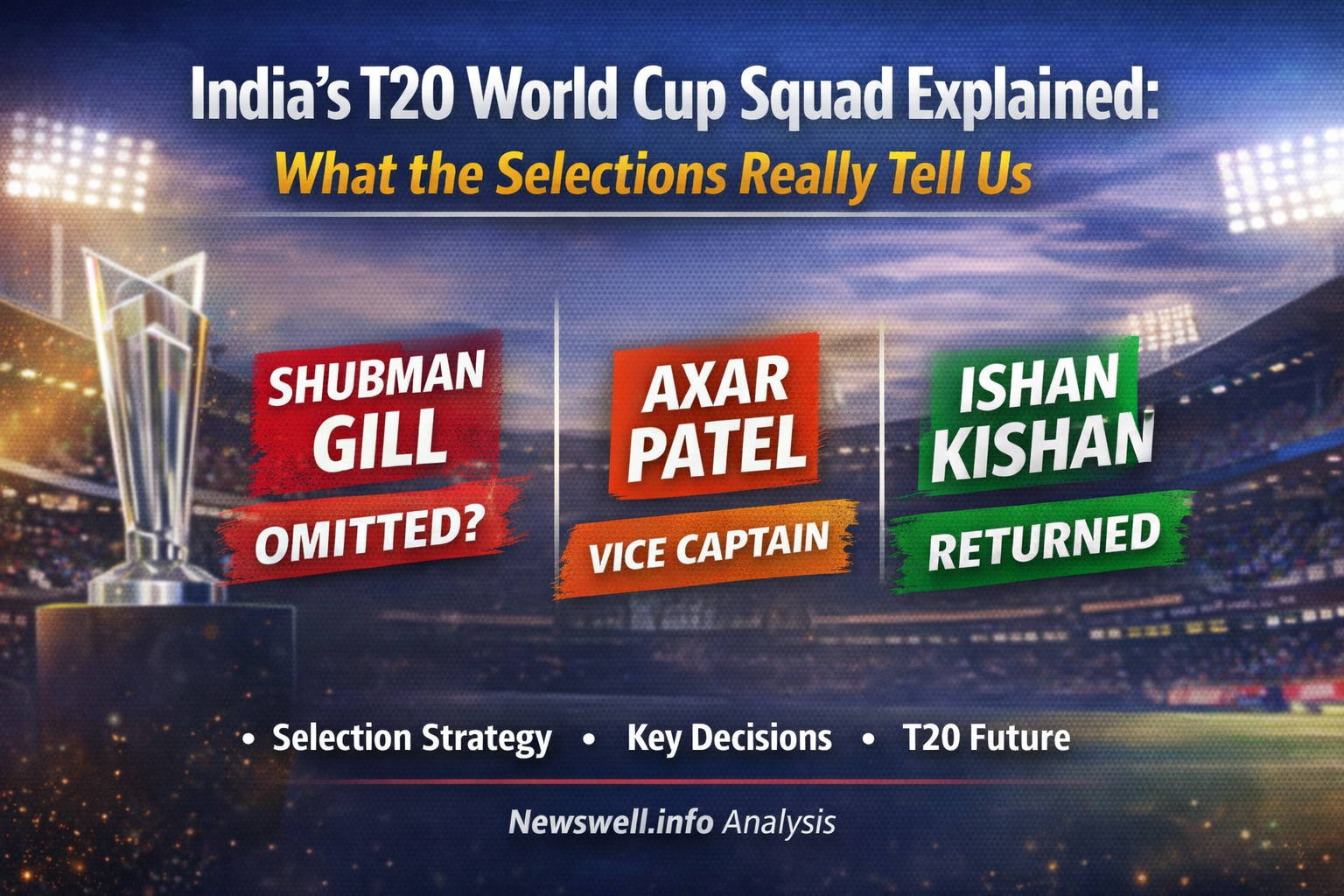
This analysis from Newswell.info breaks down the key decisions – including dropping Shubman Gill, making Axar Patel vice-captain and the return of Ishan Kishan – with context, not emotion.
Shubman Gill Question: Omission or strategic exclusion?
Shubman Gill’s ouster immediately hit the headlines. On paper, the decision seems counter-intuitive. Gill has been one of India’s most consistent batsmen across all formats and has time and again shown temperament under pressure.
Then, why was he released?
The answer probably lies not in capacity, but in format-specific demand. T20 Internationals, especially the World Cup, are becoming increasingly unforgiving. Powerplay acceleration, boundary frequency, and adaptability to batting situations matter more than classical technique.
Gill’s strengths – timing, shot selection and innings building – shine brightest in ODIs and Tests. In T20, where teams demand immediate impact, even a technically superior batsman can compete against players better suited to the role.
From Newswell’s perspective,it’s good that Shubman Gill is not part of this T20 World Cup squad – and Indian cricket should stop treating every omission as an injustice.
What is more worrying is how quickly the stories about Gill moved – from being the “next star” to early captaincy talks. Even legends like Rohit Sharma and Virat Kohli were not handed the leadership without years of sustained T20 success.
Including Gill in that conversation so early breeds entitlement, not excellence.
Shubman Gill is not a proven T20 star – he is largely a manufactured star, built through narrative, endorsements and long-term patronage rather than undisputed T20 dominance. His reputation has grown faster than his impact in this format. Constant selection, branding and promotion have catapulted Gill into the “must-pick” conversation in T20 cricket without ever conclusively achieving that status.
The “Prince” narrative is empty branding – a title bestowed without any conquests. Gill has been elevated not by dominance in T20 but by safety and composure. At the World Cup, prestige not earned is wasted, and this lapse finally acknowledges that reality.
This is why their exclusion matters: It breaks the cycle where perception trumps performance. The purpose of the World Cup is not to reward projected greatness or curated stardom – they are to select players who have already proven they can change games under the pressure of T20s. Dropping the gills is not drastic; This is overdue course correction.
A clear shift: experts over reputation
One consistent theme runs through this squad:
Expertise, Instead of collecting the most popular or experienced names, the selectors have focused on specific matching scenarios:
Who can change the game in 12 balls?
Who offers two skills instead of one?
Who fits into a flexible batting or bowling combination?
This explains why some players miss out despite strong CVs – and why others with narrower but sharper T20 skill sets are favoured.India’s previous T20 World Cup failures often stemmed from imbalance:
Too many anchors,
Too few impact options, or
A bowling attack that lacked depth.
This squad seems designed to minimize those weaknesses, even at the expense of tough misses.
Akshar Patel as vice-captain: A quiet but message-giving call
Axar Patel’s appointment as vice-captain has raised questions – not because of his talent, but because of his talent.
Letters are not an attractive option. He’s not the loudest voice on the field or the most famous name on the television panel.
But he possesses qualities that selectors increasingly value in T20 cricket:
Role clarity
Match awareness
Taking decisions
Calmly under Pressure
Contribution in all subjects
As a bowling all-rounder, Akshar provides a balance that few players can match. His presence allows teams to lengthen batting lineups without compromising bowling options – an important factor in high-pressure tournaments.
From Newswell’s perspective, Axar Patel’s rise highlights the difference between earned credibility and manufactured stardom. While some players have been elevated by hype and early appointment, Axar has earned his place in the leadership through output, adaptability and repeated delivery under pressure. He wasn’t just labeled a future star – he became indispensable. This difference matters in the T20 World Cup. The letter represents achievement before recognition, not the other way around, which is why trusting it with responsibility makes more sense than supporting a reputation built on projection rather than evidence..
The leadership debate: bold thinking or unnecessary risk?
Naturally, this decision invites debate. Is Axar Patel the right leadership backup in a World Cup setting? Would the risk be reduced by a more established captaincy option?
The truth probably sits somewhere in the middle.
While Akshar may lack long-term captaincy experience at the international level, modern T20 leadership often revolves around execution rather than inspiration. Bowling variations, field placements and reading the game matter more than motivational speeches.
The selectors believe that leadership in this team will be distributed, not centralized – with multiple players contributing tactical input rather than relying on a single voice. Then again, vice-captaincy of letters may be less about hierarchy and more about stability.
Ishan Kishan’s comeback: A message beyond selection
One of the quieter but more meaningful decisions was the inclusion of Ishan Kishan, who was rewarded after strong domestic performances.
In recent years, Indian cricket has faced criticism for appearing overly dependent on IPL performances while downplaying domestic tournaments. Kishan’s withdrawal suggests a recalibration.
This selection sends a clear message: domestic cricket still matters.
From Newswell’s perspective, this is one of the most encouraging signs in the team’s announcement. This reinforces the idea that consistent effort outside the IPL spotlight is still a viable path back into the national team. For young players and fringe contenders, this restores confidence in the selection ecosystem.
The big picture: What this team says about India’s T20 identity
Overall, these decisions paint a picture of a team trying to grow.
India appears to be moving away from this:
One-size-fits-all selection
Reputation-Based Security Selection
overlapping skill sets
And moving forward:
Defined roles
Strategic flexibility
Effect-driven selection
It does not guarantee success. The T20 World Cup is extremely unpredictable. But this shows that the lessons learned from previous tournaments are being taken seriously.
Importantly, this clause also reflects acceptance of the trade-off. Excluding popular players invites backlash, but sticking to the old formula invites failure again and again. The selectors appear to be willing to absorb criticism in the name of structural reform.
Why would this squad be evaluated differently?
Public perception often evaluates teams based on star power. But in the World Cup, teams are evaluated on the basis of execution.If India succeeds, this squad will be remembered as brave and visionary. If India fails, the same decisions will be termed as misuse. This is the reality of elite sport.
However, from an analytical perspective, the reasoning behind the selections is clearer than it may initially appear. The decisions are in line with trends seen in globally successful T20 teams – teams that value balance, versatility and clarity over emotion.
Final Verdict: A squad built on intention, not comfort
This T20 World Cup squad can’t please everyone – and maybe that’s the point.
India appears to be choosing intention over comfort, role over prestige and preparation for the future over familiarity. Whether this approach yields results or not will only be known on the field. But as a strategic exercise, selection reflects a system that is trying to adapt rather than replicate.
At Newswell.info, we believe this squad deserves analysis, not outrage. It represents a moment of change – one that could define India’s T20 identity for years to come.
Frequently Asked Questions (FAQs)
It appears that Shubman Gill’s omission is based on format-specific requirements rather than the overall form. The selectors seem to have prioritized players who offer immediate impact, high strike-rate flexibility and role adaptability in T20 cricket. Gill remains a valuable asset for the ODIs and Tests, but he might not fit into the tactical role that India are targeting for this T20 setup.
No, being left out of a World Cup squad does not mean Gill is out of India’s long-term T20 plans. Selection decisions often change depending on circumstances, opposition and team balance. Gill’s consistency across formats keeps him firmly in contention for future T20 series.
Yes. The shaft indicates a change towards: More T20 experts than players of all formats Defined roles instead of reputation-based selection More emphasis on flexibility, bowling depth and impact potential This reflects lessons learned from previous T20 World Cup campaigns
Read More : https://newswell.info/bangladesh-unrest-violence-minority-safety-analysis/