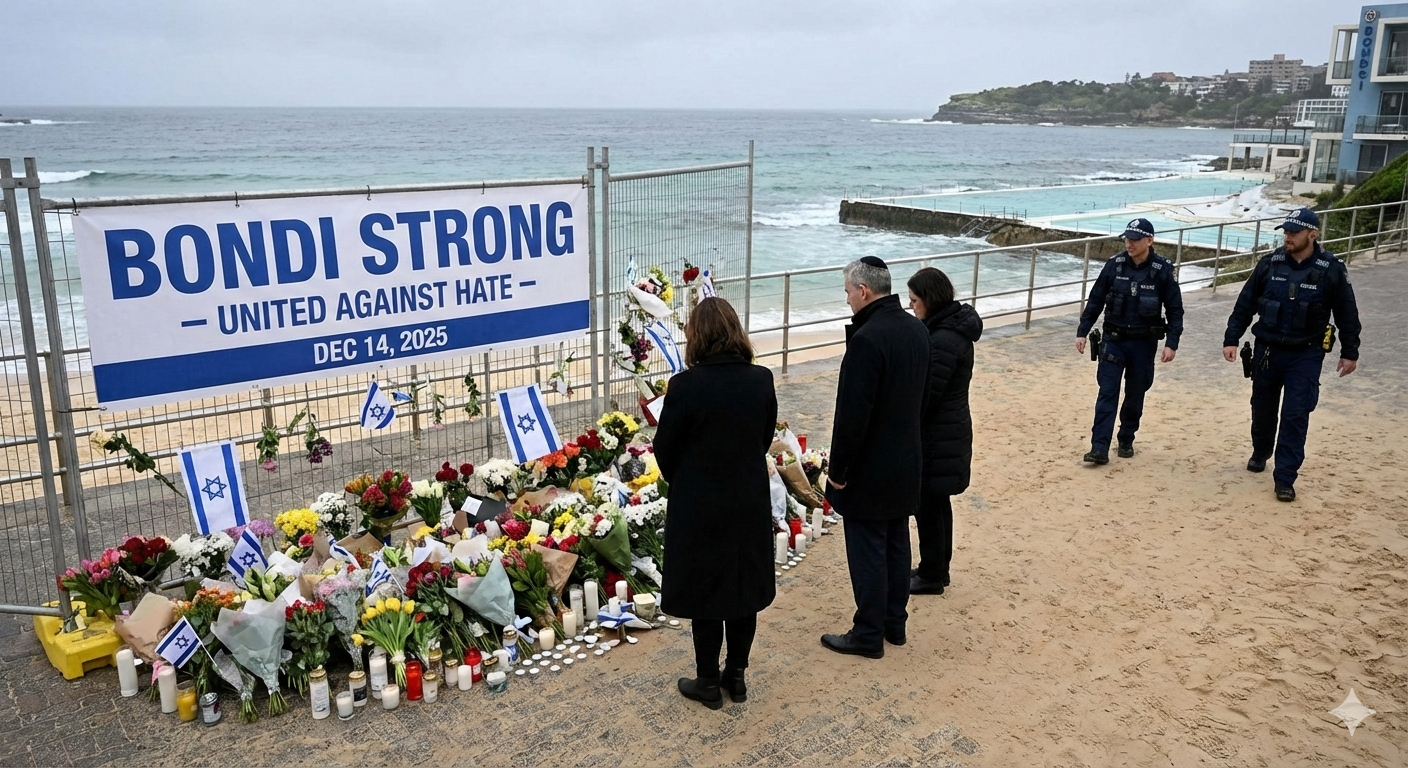
On 14 December 2025, Sydney’s Bondi Beach – usually a symbol of summer, tourism and peace – became the site of a targeted terrorist attack during a Jewish Hanukkah celebration (widely reported as a “Chanukah by the Sea”/Hanukkah-on-the-Beach event). In a matter of minutes, the story transformed from a local emergency to a national shock: a mass shooting that authorities declared terror-related and anti-Semitic, leaving the death toll soaring and dozens injured. (Source: Wikipedia https://share.google/lt5XmUdLFiN54PUG)
This article breaks down what is known so far, what is still unconfirmed, and big “newswell-style” insights – second-order impacts on social stability, security policy, markets, and information ecosystems.
What happened on Bondi Beach?
Authorities and major outlets report that the attack occurred during a Hanukkah gathering, attended by about 1,000 people, when two gunmen opened fire. Emergency services were immediately called, and the scene became a large-scale triage and counter-terrorism operation.
Casualties and injuries (initial reporting)
Initial reports varied slightly by outlet, according to data updated by hospitals and police. Reuters reported the death toll to 16 in an update, while the AP reported at least 15 dead, with more than 40 injured/hospitalized. The final numbers are expected to be confirmed after formal identification and medical updates.
How did the attack end?
Reporting indicates that one attacker was killed by police at the scene, and the other was injured and detained/placed under guard. Many firearms were used.
Who were the culprits behind this?
Based on police identifications reported by news outlets, the suspects are father and son:
Sajid Akram (father) – Reportedly killed on the spot
Navid Akram (son) – seriously injured/reportedly in custody under protection
Pre-screening and “missed-signal” debate
One of the most serious revelations in the reporting is that Naveed Akram was investigated by Australia’s security services in 2019 for alleged ties/links to an extremist cell (as reported by ABC). This does not automatically mean that the crime could have been predicted or prevented – but it will sharpen scrutiny of how threat assessments are closed, downgraded or revisited over time.
Weapons, equipment and increased risk
Investigators reportedly found an improvised explosive device (and other suspicious material reported in some coverage) linked to the incident. Even if it did not explode, the presence of the IED transforms the incident from a “mass casualty shooting” to a multi-vector terror effort, which changes how officials will model future threats.
Why are officials calling it terrorism?
Authorities described it as a targeted, anti-Semitic terrorist attack, primarily because:
The target was a Jewish religious festival The violence appears to have been designed to intimidate a community and create widespread fear (a core terrorist objective).
The international response has also framed it in the context of rising tensions globally and increasing anti-Semitic incidents, which may impact the risk situation around religious events even outside Australia.
The hero factor – and why it matters Multiple outlets highlighted a bystander who physically intervened during the stampede, potentially causing further casualties. These moments matter not only emotionally, but also operationally: after-action reviews often show that seconds saved in disruption can prevent mass casualties.
Newswell style insights:
What really changes this phenomenon?
News headlines will focus on identity, motive and policing – but the deeper story is what it does to the system: trust, security, business confidence and the national mood. Here are the high-signal implications that readers (and policymakers) should track next.
1) Australia’s “security paradox”: open public life versus strict targets Bondi Beach is not a “normal” high security area. That’s the point. Public spaces are certainly soft targets because they represent everyday life – and because heavy security there changes the character of society. After such an attack, the pressure becomes tight:
- religious gatherings,
- public holidays,
- festivals,
- Beaches,
- coasts, and event venues,
But it’s impossible to make everything strict.
The potential policy change is risk-tiered:
certain incident types will get higher baseline security, intelligence presence, perimeter control and rapid-response staging.
2) The intelligence accountability cycle is back.
Whenever reporting includes “investigated earlier in 2019”, the public conversation becomes predictable: “Why wasn’t he stopped?” “Was it failure or simply non-predictability?” “Were resources diverted?”
Key Insight: Modern counterterrorism is less about “knowing everything” and more about prioritizing under uncertainty. After Bondi, expect:
Parliamentary/media pressure on ASIO and Joint Counter Terrorism Team processes Renewed debate around watch list, limit and revaluation trigger
3) Community stability becomes a national security issue The NSW Police leadership’s insistence on calm and warning against reprisals (as reported) indicates a real concern: terrorist attacks could set off a “chain-reaction” in retaliatory violence, hate crimes and social cleavages.
Terror wants a second explosion – social, not physical. The quickest victory for extremists is not just casualties; This is polarization.
What to see: Increased security at Jewish sites visible interreligious statement Enforcement stance against hate crimes, online incitement and harassment
4) Economic wave: tourism, retail, insurance and city confidence Bondi is a global brand. When a terrorist event reaches a globally known milestone, economic shocks may include: short-term tourism hiccups Cancellation of major public events Event Security Costs Increase Insurance Reassessment for Large Gatherings and Venues Markets don’t just react to “macro data.”
They respond to perceived stability and risk costs. The direct financial loss is tragic – but the broader economic drag comes from the added “friction” in public life.
5) The battlefield of misinformation will intensify Within hours of major events, social feeds are filled with: misidentified suspects recycled video Fake “Manifesto” Edited clips that provoke tales of retribution. A clear timeline (based on initial reporting) Because public understanding matters, here’s a simple timeline structure you can use in your newsweekly coverage (keep updating as the official briefing arrives): December 14, 2025 (evening): Shooting begins during Hanukkah beach event
A few minutes later: emergency response, police activation; One attacker killed, another injured/detained 15 December 2025: Officials/media update on death toll, identification of suspects and prior security attention What’s next: 5 developments worth watching Formal charges/court process (once surviving suspect is medically cleared) reuters Changes in security arrangements for public religious/cultural events across the country news.com.au ASIO/policing review around prior investigations and risk downgrades Hate crime monitoring and community safety measures The debate over gun policy is returning to the spotlight, especially if any gun access loopholes are revealed (even if laws remain unchanged, public pressure often increases after a mass shooting).
Bondi is now a national warning sign Bondi Beach shooting will recover – Sydney always does – but the meaning of the event will remain. A terrorist attack on a historic public place is a message to everyone: “You are not safe even in normal life.” Society’s reaction determines whether that message will stick or not.
Newswell’s conclusion is:
The strongest answer is not only strategic security. It is institutional clarity, community cohesion and information discipline. The next few weeks will show whether Australia can minimize the secondary damage – polarisation, fear and copycat – while delivering justice and strengthening prevention.
This story is developing. Updates will follow as more verified information becomes available.
Read More Interesting : https://newswell.info/forbes-under-30-2026-list-analysis/