
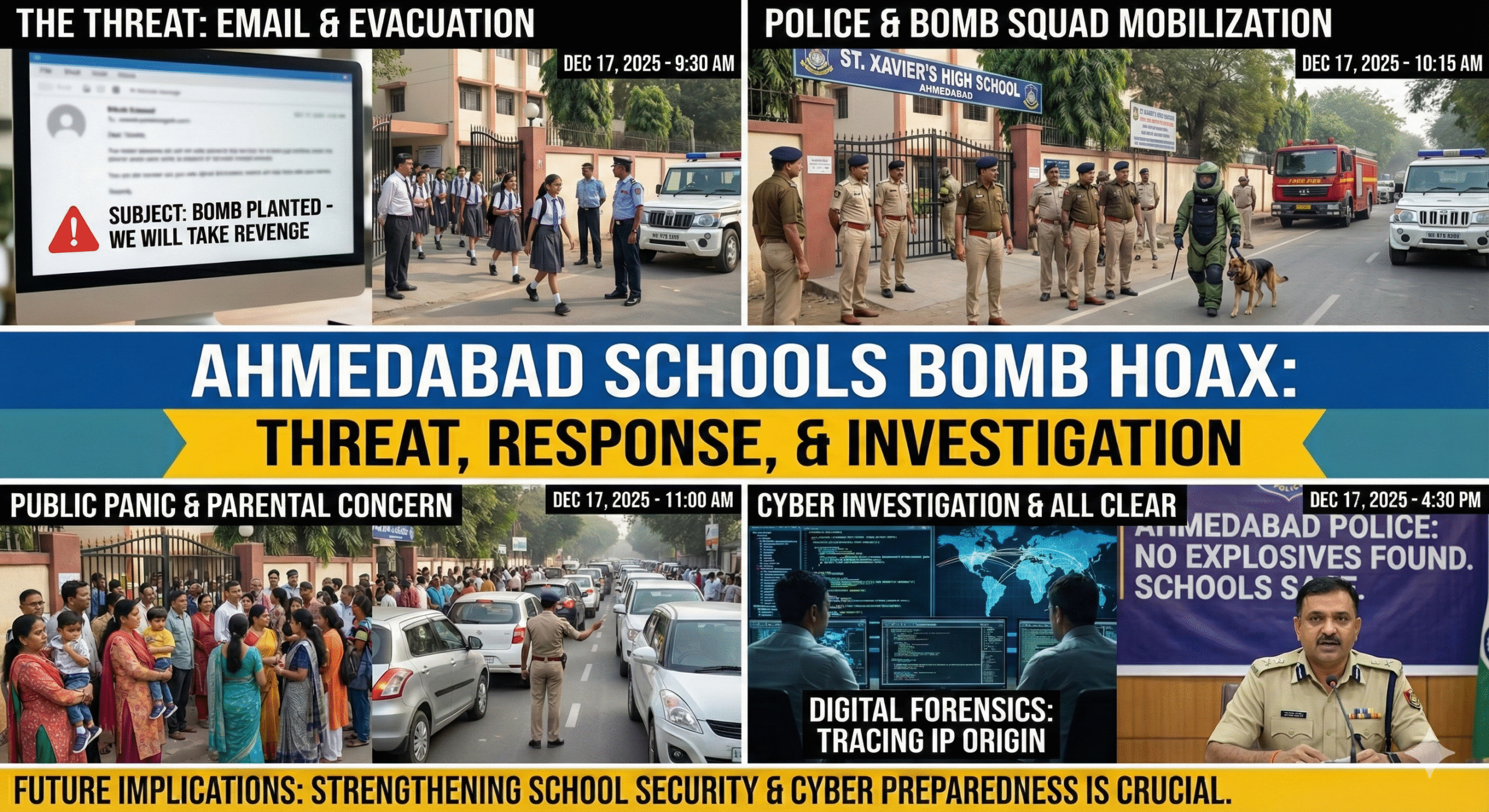
On December 17, 2025, Ahmedabad – one of the busiest and most populous cities of Gujarat – was in the news after several bomb threat emails were sent to schools in the city and surrounding districts. The incident sparked widespread concern, prompting evacuations of schools, heavy police deployment and immediate questions about cyber threats and public safety at educational institutions.
In this News Insight, we analyze the entire episode – from the threatening email and police response to the public reaction and future implications – so you can know what really happened and how authorities handled it.
What happened: Bomb threat emails
On Wednesday morning, several schools in Ahmedabad received alarming emails claiming that bombs had been planted on their premises. These emails were sent to at least 10 to 30 schools in nearby areas including Ahmedabad and Gandhinagar, prompting the authorities to immediately alert and take emergency action.
The email contained threatening language intended to cause fear and disruption, with some references to explosive devices. In at least one case, the message in the email reportedly said, “We will take revenge,” underscoring the intended threatening effect.
Because schools take any threat to children’s safety seriously, administrators did not take the email lightly. Instead, they immediately contacted police, triggering one of the fastest coordinated emergency responses seen in the city’s recent history.
Immediate Security Response
Upon receiving information about the threats, Gujarat Police, Bomb Detection and Disposal Squad (BDDS), Crime Branch units, fire brigade teams and dog squads were immediately mobilized and sent to the affected schools.
Main activities included:
Evacuation of students and staff from school premises
Deploying security personnel and emergency responders
Intensive inspection of classrooms, playgrounds, gates and common areas
Temporary closure or early dismissal of classes
The police acted methodically and professionally, treating each bomb threat email as genuine until cleared by search teams.
abp live
Importantly, after a thorough investigation by bomb disposal units, no explosive device or hazardous material was found in any of the schools. This helped avert what could have been a tragic situation.
Public reaction: parents and traffic chaos
As soon as the news spread, parents rushed to school premises to pick up their children, causing congestion and traffic snarls near many campuses.
The situation was tense – parents were worried about the safety of their children, there were traffic jams around school zones, and social media was buzzing with urgent updates. Many parents shared real-time messages with their children about the evacuation and reunification.
Despite ultimately clear signals from authorities, the public’s concern revealed how deeply these threats affect community trust and daily life – even if they prove to be hoaxes.
Officials have confirmed this
After rapid deployment and inspection:
- No explosive device found in any school
- Safety checks completed and declared safe
- Schools advised by education officials to resume normal classes the next day
- Police and cyber crime units begin investigation into the source of the email
The District Education Officer (DEO) in Ahmedabad later reassured parents and teachers and confirmed that schools would function normally after the threat was removed and security checks were completed.
The authorities also stressed their commitment to thoroughly investigate the digital footprints of threatening emails and identify the senders.
Cyber Crime and Investigation: Detecting Threats
An important part of the response is not just physical security but cyber investigations.
Bomb threats sent via email are part of a growing trend where malicious actors take advantage of digital platforms to cause disruption in the real world. These emails are often sent from remote servers using techniques such as VPN masking and foreign IP routing, making it difficult to immediately trace the origin.
Officials confirmed that cybercrime units have been activated to trace email headers, IP pathways and other digital markers to identify where the threats originated. In previous similar cases, such investigations sometimes took weeks or months, involving collaboration between local police, state agencies and national cyber units.
This type of digital forensics work is slow and complex, which is why officials repeatedly emphasize that every bomb threat – even if proven to be a rumor – should be treated as a serious security issue until proven otherwise.
Why does this event matter?
At face value, false bomb threats may seem like a joke – but their real implications are darker:
1. School security vulnerabilities
This incident highlights how easily digital messages can cause widespread fear and disruption if schools are not properly prepared to respond quickly and calmly.
2. Emergency preparedness and training
The ability of schools and authorities to evacuate quickly without chaos demonstrates effective emergency procedures – but it also points to the need for ongoing training in crisis communication and management.
3. Awareness of cyber threats
Understanding how cybercriminals manipulate digital communications to create panic is essential for future prevention measures – not just in schools but in public institutions and critical infrastructure.
4. Community Trust
Repeated fraud – even without physical threat – undermines trust in the information ecosystem and emphasizes the importance of transparency and verified reporting.
Similar cases and broader references
The Ahmedabad case is not an isolated incident. Over the past few years, across India, a number of bomb threat rumors have emerged targeting schools, airports, hospitals and public spaces – all using email as a delivery mechanism.
Technical analysts and security experts say these incidents often follow a global pattern where threats are designed to mimic real terrorist communications, heighten fear and test the security response.
This trend underscores the need for a coordinated digital threat response framework and community education on how to differentiate credible alerts from malicious fraud.
What parents and schools can do next
For Parents:
- Stay informed only through verified sources and official announcements
- Avoid spreading unverified information on social media
- Ask schools about their emergency notification protocols
For Schools:
- Conduct regular security drills and cyber-awareness training
- Coordinate with local police on emergency response planning
- Invest in digital security infrastructure to detect and report threats
For Officers:
- Expand cyber crime investigation resources
- Improve public communication strategies during emergencies
- Collaborate with national cyber units to pinpoint the origin of the threat
Final Thoughts
Bomb threat emails sent to Ahmedabad schools this week were worrying – but thanks to the quick response of Gujarat police and emergency teams, no students or staff were harmed.
What started as a frightening morning of potential danger turned into a citywide reminder of the challenges posed by cyber-enabled threats in the real world. It also showed how necessary coordinated efforts between schools, law enforcement and cyber units are to protect communities.
As the investigation continues and officials work to determine the source of these threats, parents, teachers, and citizens alike have a shared responsibility to stay informed and support security preparedness.
For verified updates, deep insights and analysis on this developing story and others like it, visit NewsWell.info – your trusted source for timely and factual reporting.
Disclaimer : This blog is based on verified reports and news sources available at the time of writing. Situations like these evolve quickly, and official findings may change as investigations progress
Read More : https://newswell.info/paris-new-year-fireworks-cancelled/