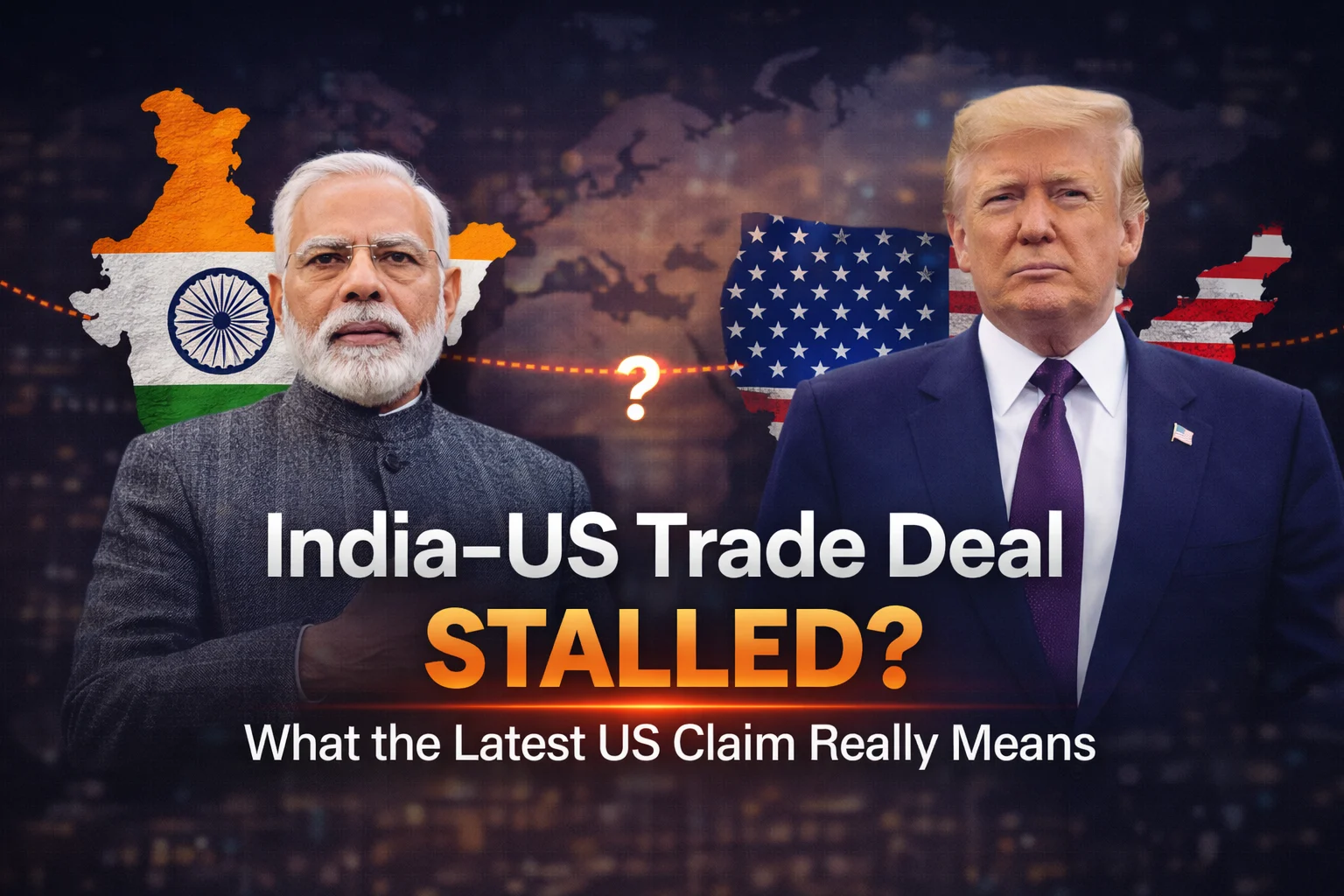
The India–US trade relationship has once again found itself at the center of global attention. A recent statement by the US Commerce Secretary has sparked debate after he claimed that the long-discussed India-US trade deal is incomplete as Prime Minister Narendra Modi did not personally call former US President Donald Trump.
This claim has raised questions in diplomatic, economic and political circles. Is the trade deal really on hold? Or is it part of the complex and often misunderstood nature of international negotiations?
In this article, NewsWell explains what the claim really means, what is at stake for both countries, and why the India-US partnership has not derailed.
Understand the US Commerce Secretary’s claim
According to the statement, the lack of direct talks between PM Modi and Donald Trump was cited as one of the reasons why the trade deal could not be finalized during Trump’s presidency. Although this claim has grabbed headlines, it is important to understand the broader diplomatic context.
Trade agreements between major economies like India and the United States do not depend on a phone call. They are the result of lengthy negotiations involving trade representatives, ministries, legal experts and economic advisers. Leadership-level communication plays a symbolic role, but it is rarely the sole deciding factor.
Newswell Insight:
Such statements are often retrospective political narratives rather than definitive explanations of why deals do or do not happen.
Why does the India-US trade deal matter?
India and the United States share one of the most significant economic partnerships in the world. Bilateral trade between the two countries has grown steadily over the years, covering the following sectors:
- Information Technology and Digital Services
- Pharmaceuticals and healthcare
- Defense and Aerospace
- Energy and Renewable Energy
- Manufacturing and Supply Chain
A formal trade agreement would aim to reduce tariffs, resolve market access disputes, and provide long-term stability for businesses on both sides.
Newswell Insight:
The lack of a final trade agreement has not stifled trade growth; It has simply limited its potential scale and predictability.
Was the deal really “on hold”?
Describing the trade deal as “stalled” oversimplifies the reality. During the Trump administration, trade negotiations faced several obstacles, including:
- Disagreement over tariffs on agricultural products
- India’s data localization policies
- America’s concerns over market access
- India’s objections to unilateral trade pressures
These structural issues required policy-level agreement, not just diplomatic gestures.
Newswell Insight:
Trade talks slowed down due to policy differences, not diplomatic isolation.
India-US relations beyond trade
It is important to separate the trade talks from broader India-US relations. Over the past decade, relations between the two countries have strengthened in a number of areas:
- strategic defense cooperation
- Indo-Pacific Security Alignment
- Technology and Semiconductor Partnership
- Climate and clean energy cooperation
Even without a comprehensive trade agreement, cooperation has expanded significantly.
Newswell Insight:
India-US relations are increasingly multidimensional, no longer dependent on any single agreement.
Why are such claims coming to light now?
Such statements often arise due to political position, legacy narratives or domestic messaging. As leadership changes and the administration reflects on past decisions, explanations are crafted in ways that are conducive to political discussion.
It does not necessarily reflect the current state of negotiations or future prospects.
Newswell Insight:
Retrospective claims should be seen as political commentary, not diplomatic decisions.
What’s next for India-US trade talks?
Under the current global economic environment, both countries have strong incentives to deepen trade relations:
- Supply chain diversification away from excessive dependence on single markets
- Expanding digital and AI-driven economies
- Strengthening Resilient Manufacturing Ecosystem
Rather than a single “big trade deal”, the future may involve multiple sector-specific agreements.
Newswell Insight:
The next phase of India-US trade relations is likely to be modular, flexible and sector-focused.
Global market impact
Markets generally react to concrete policy changes, not just statements. So far, the claim has not caused any significant market volatility, reflecting investor confidence in the long-term strength of India-US relations.
Newswell Insight:
The market sees continuity, not conflict.
Conclusion: The conversation is not over
Although the US Commerce Secretary’s claim has sparked debate, it does not signal a decline in India-US trade relations. Diplomatic engagements evolve over time, shaped by economic priorities, political realities, and global circumstances.
The idea that a phone call could determine the fate of a complex trade agreement underestimates the depth of modern diplomacy. As things stand, the India-US trade dialogue remains vibrant, productive and forward-looking.
Diplomacy continues. The conversation is not over.
Unique FAQs (Newswell Exclusive)
No. Trade agreements depend on policy negotiations, not individual calls. The claim simplifies a much broader process.
No. There is no official cancellation. Discussions continue through various diplomatic and trade channels.
Differences over tariffs, regulations, and market access have delayed finalization.
No. Strategic and economic cooperation continues to grow across multiple sectors.
More sector-specific agreements and gradual easing of trade barriers rather than one single sweeping deal.