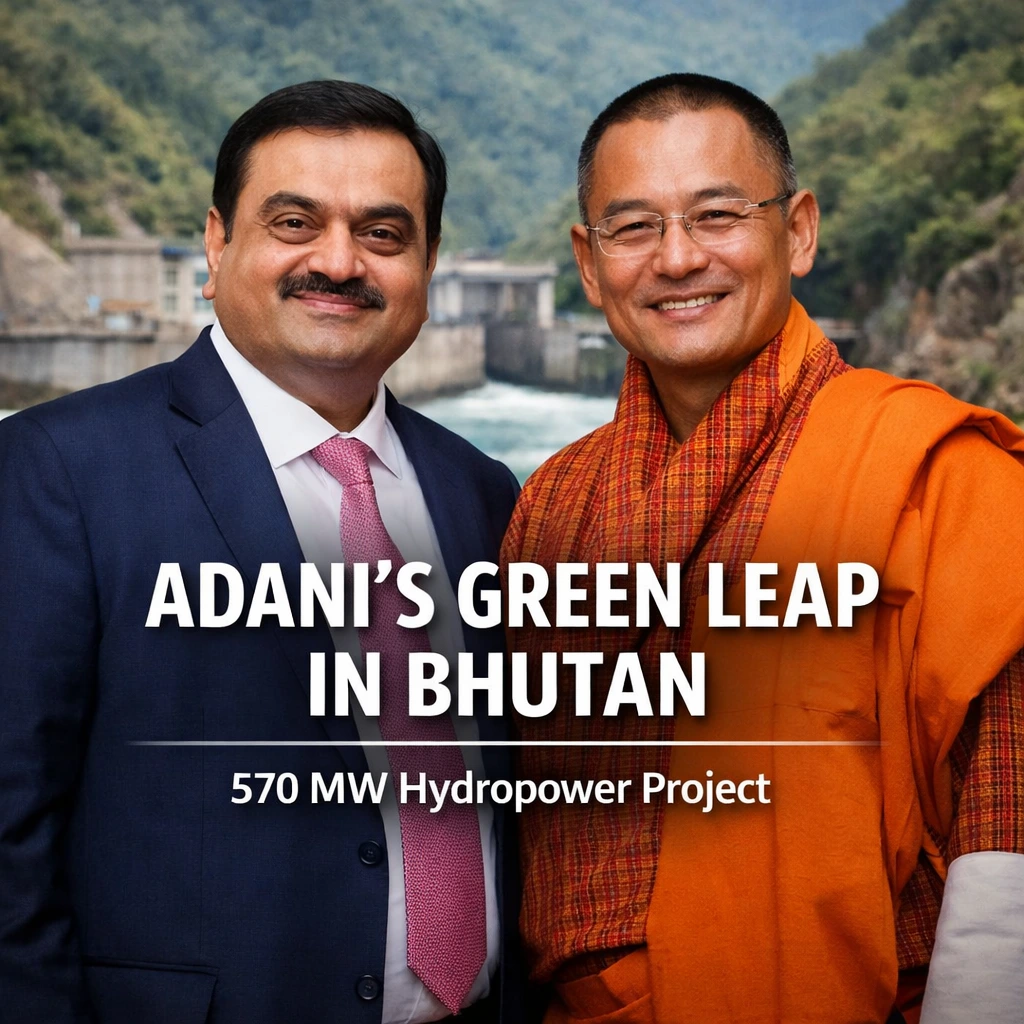
The Adani Group has taken a significant step in South Asia’s clean-energy transition with the launch of a 570-megawatt hydropower project in Bhutan. The development, widely described as a green leap for the Himalayan nation, underscores a deepening partnership between India and Bhutan in renewable energy, infrastructure, and long-term sustainability.
At a time when countries across the region are balancing growth with climate commitments, the project places hydropower—one of the most reliable renewable sources in mountainous terrains—at the center of future energy planning
A Strategic Project on the Wangchhu River
The new hydropower facility, located on the Wangchhu River, is being developed as a joint venture with Bhutan’s state-owned utility, Druk Green Power Corporation (DGPC). Under the partnership structure, DGPC holds a majority stake, while Adani Group contributes technical expertise, project execution capabilities, and access to regional energy markets.
This ownership model reflects Bhutan’s long-standing policy of retaining sovereign control over its natural resources while leveraging foreign collaboration for scale, financing, and efficiency.
Hydropower already forms the backbone of Bhutan’s economy, accounting for a substantial share of government revenue through electricity exports—primarily to India. A Strategic Project on the Wangchhu River
The new hydropower facility, located on the Wangchhu River, is being developed as a joint venture with Bhutan’s state-owned utility, Druk Green Power Corporation (DGPC). Under the partnership structure, DGPC holds a majority stake, while Adani Group contributes technical expertise, project execution capabilities, and access to regional energy markets.
This ownership model reflects Bhutan’s long-standing policy of retaining sovereign control over its natural resources while leveraging foreign collaboration for scale, financing, and efficiency.
Hydropower already forms the backbone of Bhutan’s economy, accounting for a substantial share of government revenue through electricity exports—primarily to India. The Wangchhu project adds another pillar to this model adds another pillar to this model.
Why This Project Matters for Bhutan
Bhutan is globally known for its Gross National Happiness (GNH) framework and strong environmental safeguards. Nearly the entire country runs on renewable electricity, and it is one of the world’s few carbon-negative nations.
However, rising domestic demand, infrastructure expansion, and climate variability have made capacity expansion essential.
The 570 MW project addresses several national priorities at once:Energy Security: Additional generation capacity reduces seasonal supply risks.Economic Stability: Long-term power exports generate predictable revenue.Climate Alignment: Hydropower supports Bhutan’s low-emissions development path.By partnering with a large regional energy player, Bhutan also diversifies execution risk while maintaining policy control.
India–Bhutan Energy Cooperation: A Longstanding Relationship
India and Bhutan share one of South Asia’s most established cross-border energy relationships. Indian companies have played a key role in building Bhutan’s hydropower infrastructure over decades, while India remains the primary buyer of Bhutanese electricity.The involvement of Adani Group signals a new phase in this cooperation—one that blends traditional state-to-state frameworks with private-sector efficiency and capital.From India’s perspective, the project supports:Clean power imports to meet growing demandGrid stability through diversified renewable sourcesRegional leadership in South Asia’s energy transitionFor Bhutan, it reinforces confidence in long-term market access.
Newswell Insights: Reading Between the Lines
Newswell Insight #1: Policy Before Promotion Unlike many renewable announcements, this project has been framed in a policy-first, non-promotional tone. That suggests strong government-level alignment and long-term confidence rather than short-term optics.
Newswell Insight #2: Hydropower’s Quiet Comeback While solar and wind dominate headlines, hydropower is regaining strategic importance in regions with suitable geography. Bhutan’s terrain makes it uniquely positioned to lead this trend.
Newswell Insight #3: Regional Energy as Diplomacy Energy cooperation here functions as quiet diplomacy. Stable power trade strengthens political trust, economic interdependence, and regional resilience without overt geopolitical signaling.
Unique FAQ
The planned installed capacity of this project is 570 MW, making it one of the recent significant additions to Bhutan’s hydropower sector.
It is a joint venture between the Adani Group and Druk Green Power Corporation, in which DGPC holds a majority stake.
Bhutan’s geography, river systems and environmental policies make hydropower the most viable and sustainable source of energy on a large scale.
While some power will meet domestic needs, a significant portion is expected to be exported to India, continuing an established energy trading pattern.