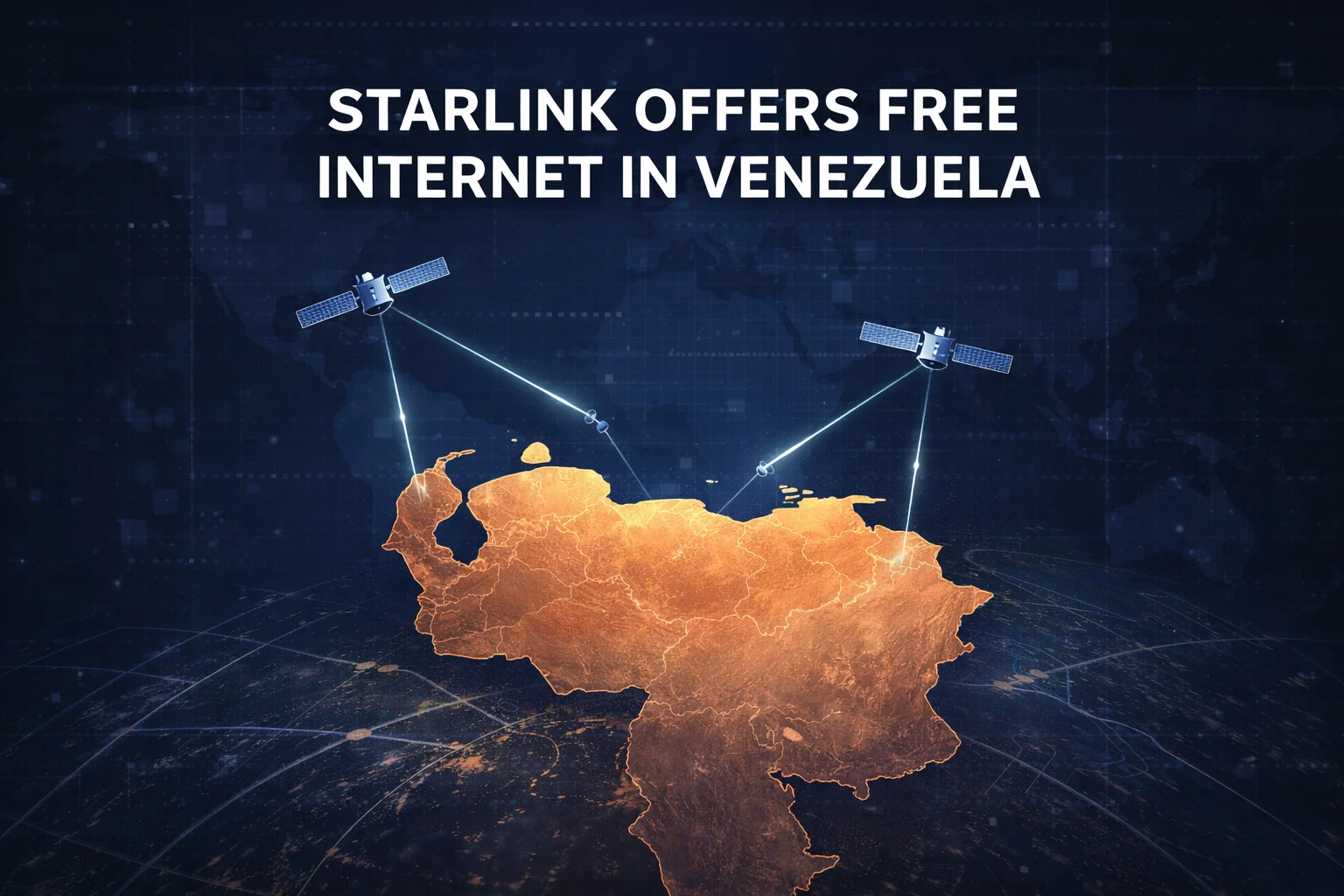
When countries face political instability or infrastructure breakdown, access to reliable communications often becomes one of the first casualties. In this context, reports that Elon Musk’s Starlink is offering free internet access in Venezuela till February 3 have attracted global attention.
This development highlights the growing reality of the modern world: satellite Internet is no longer just a commercial service – it is increasingly becoming a strategic tool during crises.
Understanding Starlink’s Role in Venezuela
Starlink, operated by SpaceX, provides high-speed internet via a constellation of low-Earth-orbit satellites. Unlike traditional broadband, it does not rely on ground-based cable infrastructure, which may be disrupted during unrest, disaster or power failure.
Venezuela has struggled for years with unreliable telecommunications, frequent outages, and limited access to uncensored digital communications. In such an environment, satellite-based connectivity could provide a temporary but vital lifeline for citizens, journalists and humanitarian groups.
Why does it matter now
Political tensions and economic pressures often go hand in hand with information blackouts. During moments of instability, access to the Internet is affected by:
- emergency coordination
- independent news flow
- financial transactions
- Public awareness and safety
By enabling free access for a limited period, Starlink positions itself as a crisis-response connectivity provider rather than just a technology company.
Newswell Insight
The move reflects a broader global shift where private tech infrastructure is increasingly filling the gaps left by governments during emergencies. While this may empower citizens, it also raises long-term questions about digital sovereignty and reliance on private actors for essential services.
Geopolitics and Technology: A New Interrelationship
The case of Venezuela highlights how technology companies now operate at the intersection of geopolitics and humanitarian needs. Internet use is no longer neutral – it can influence narratives, transparency, and even international reactions.
Starlink’s involvement doesn’t change Venezuela’s political reality overnight, but it does change who controls access to information, even temporarily.
Limitations and open questions
Although the initiative has been widely discussed, several uncertainties remain:
- How widely accessible will the service be on the ground?
- Will users need existing Starlink hardware?
- What happens when the free access window ends?
These questions highlight the complexity of deploying advanced technology in economically stressed regions.
Newswell Insight
Short-term connectivity may bring immediate relief, but long-term digital resilience still depends on stable institutions, infrastructure investment and policy reform. Starlink’s role can be influential—but it is not a substitute for systemic solutions.
Conclusion
Elon Musk’s Starlink reported decision to provide free internet in Venezuela represents more than a technological gesture. This reflects a changing global order where communications infrastructure, once the domain of states, is now increasingly being shaped by private innovation.
As the crisis continues to test traditional systems, satellite Internet could become one of the most influential tools in maintaining citizen connectivity and global awareness.
Frequently Asked Questions (FAQ)
Starlink is a satellite Internet service that uses low-Earth-orbit satellites to deliver broadband without relying on cables or towers.
It helps in communication, access to information, emergency coordination and maintaining economic activity.
Availability varies, and usage often depends on hardware access and regulatory conditions.
Reports indicate availability until February 3.
Not necessarily. Long-term access depends on policy, affordability and infrastructure decisions.