
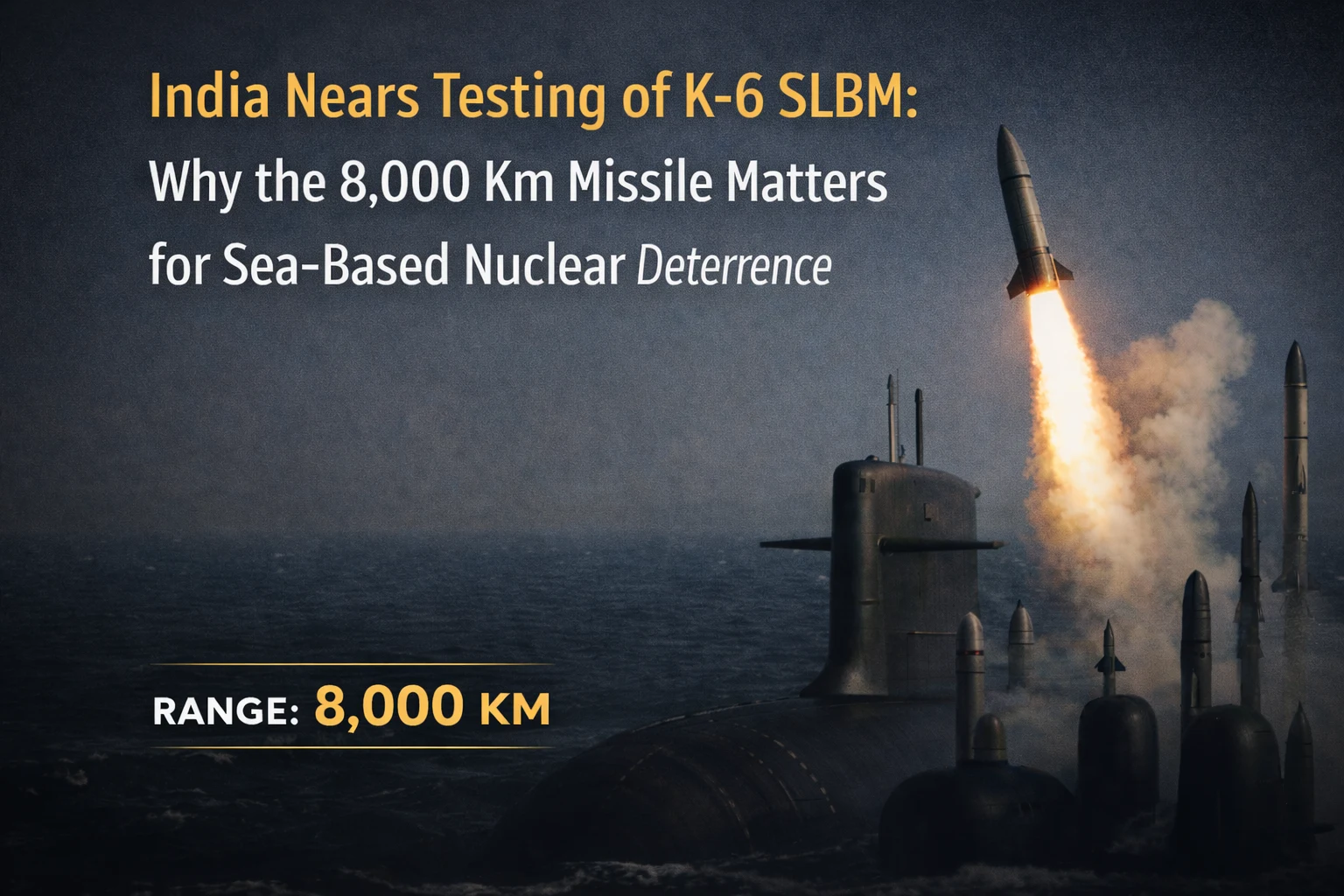
India is fast approaching a major milestone in its strategic defense capabilities with preparations for the test of the K-6 Submarine-Launched Ballistic Missile (SLBM). With a projected range of up to 8,000 kilometres, the K-6 represents a significant leap forward in India’s long-range strike capability and strengthens the most critical prong of its nuclear doctrine – sea-based deterrence.
Although official confirmation is limited, multiple defense reports indicate that the missile is being developed as part of India’s long-term effort to increase the survivability, reach, and reliability of its nuclear forces. Unlike land-based systems, submarine-launched missiles provide a safe second-strike option, making them central to strategic stability.
What is K-6 SLBM?
The K-6 is considered to be the most advanced missile in the K-series of submarine-launched ballistic missiles of India developed under the Defense Research and Development Organization (DRDO). It is designed to be deployed from nuclear-powered ballistic missile submarines (SSBNs), which form the backbone of India’s underwater nuclear deterrent.
With a reported range of approximately 8,000 km, the K-6 will significantly outperform previous systems such as the K-4 and K-5. This extended range allows submarines to operate safely in distant waters, while maintaining the ability to reach strategic targets when needed.
Why Sea-Based Deterrence Is Critical
India follows a No First Use (NFU) nuclear policy, which means it is committed to using nuclear weapons only in retaliation. For such a doctrine to remain credible, a country must ensure that it can respond even after receiving a first strike.
This is where sea-based nuclear weapons become necessary.
Submarines carrying nuclear missiles are extremely difficult to detect and disable. Even if land-based missile sites or air bases are compromised, SSBNs hidden in deep water ensure retaliatory capability. The K-6 missile is being developed to strengthen this layer of deterrence.
Strategic Border: Why does 8,000 kilometers change the equation?
The range of 8,000 km places the K-6 among the longest range submarine-launched missiles globally. The range offers three key strategic benefits:
- operational flexibility
Indian submarines would not need to go close to the hostile coastline, thereby reducing the risk of detection.
- comprehensive target coverage
The missile’s reach allows coverage over vast geographic areas, increasing deterrence capabilities.
- increased survival
Longer range means submarines can patrol safe waters while remaining operationally effective.
This combination strengthens deterrence without the need for aggressive forward deployment.
Technology and Capabilities (what is known so far)
While official technical details are classified, defense analysts believe the K-6 will have these features:
- Advanced solid-fuel propulsion
- Multiple warhead capability (potential MIRV integration)
- High accuracy through improved guidance systems
- Compatibility with next-generation Indian SSBNs
These features are in line with India’s long-term roadmap to maintain strategic parity and credible deterrence in a rapidly evolving security environment.
How does K-6 fit into India’s nuclear triad?
- India’s nuclear triad includes:
- land based missiles
- air-delivered nuclear weapons
- Sea based missiles launched from submarines
Of these, the sea-based foot is considered to be the most survivable. K-6 is designed to further strengthen this leg, ensuring that India’s deterrence capability remains intact in all scenarios.
With submarines already operational and under development, the K-6 will serve as a future-ready system supporting long-term strategic stability.
Regional and global implications
The purpose of the development of K-6 is not to increase tension but to reduce it. However, it has implications for regional security dynamics.
- This signals India’s commitment to maintain credible minimum deterrence
- This underlines the technological maturity in underwater missile systems
- It enhances strategic stability by strengthening second-strike assurance
To global observers, the K-6 reflects India’s systematic and principle-driven approach to nuclear capability rather than reactive or aggressive expansion.
NewsWell Insight: Why this development matters more than it seems
Newswell Insight:
The K-6 missile is not just about range or technology – it is about reliability. In modern nuclear strategy, deterrence is less about numbers and more about assurance. By strengthening its sea-based capabilities, India is strengthening the most stable component of its nuclear doctrine.
Unlike headline-grabbing tests, K-6 represents quiet, long-term planning. This reflects India’s focus on survival, restraint and strategic balance rather than symbolic displays. This makes the K-6 one of the most consequential – yet underrated – defense developments in recent years.
what comes next?
Although the timeline for testing has not been disclosed, defense observers expect gradual verification rather than rushed tests. The missile is likely to undergo phased testing before full operational deployment.
Once inducted, K-6 will be a major step forward in India’s maritime deterrence posture, ensuring long-term strategic security in an increasingly complex global environment.
Frequently Asked Questions (FAQ)
K-6 is an advanced submarine-launched ballistic missile being developed by India, with an estimated range of up to 8,000 km.
It strengthens India’s sea-based nuclear deterrence capability, ensuring a secure second-strike capability.
This missile is being developed by India’s Defense Research and Development Organization (DRDO).
The K-6 is designed as part of India’s nuclear deterrent and is expected to be nuclear-capable.
It offers significantly longer range and more advanced capabilities than earlier K-series SLBMs.