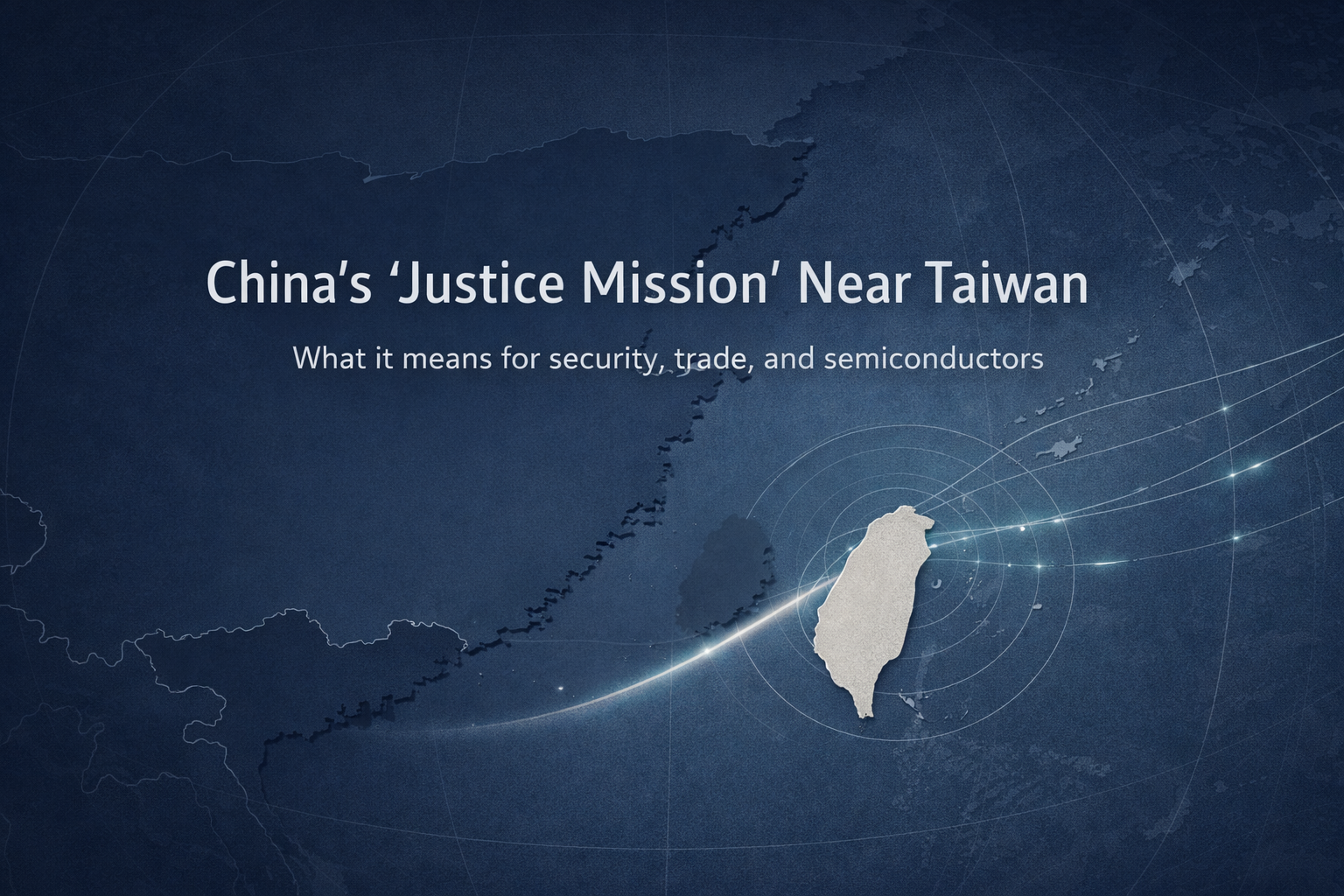
China has launched a major military operation near Taiwan, officially calling it a “justice mission.” At first glance, the announcement may seem like another round of routine military exercises in a region already accustomed to tension. But a closer look reveals that the move is carefully thought out, politically significant and strategically important – not just for Taiwan and China, but for the global economy as well.
This Newswell Insight explains what exactly this operation involves, why Beijing is using such language, how Taiwan is responding, and why the world—especially markets and supply chains—is paying attention.
What exactly is “Justice Mission”?
The operation has been carried out by China’s armed forces, officially known as the People’s Liberation Army (PLA). According to the Chinese state message, the mission includes coordinated exercises across multiple domains:
- Naval activities in and around the Taiwan Strait
- Air Force flights, including fighter jets and support aircraft
- Missile and surveillance units operating as part of joint command exercise
The important thing is that China has not described it as a war exercise against any specific enemy. Instead, it has framed the operation as a legitimate and justified action aimed at maintaining sovereignty and preventing what it calls “provocations“.
This distinction matters. The term “justice mission” is not a neutral military label – it is a political signal, aimed at domestic and international audiences as well as Taiwan.
Why is China using the word “justice”?
Beijing’s language is deliberate. By calling the operation Justice Mission, China is sending three overarching messages:
1. Claim of sovereignty
China considers Taiwan part of its land territory, despite Taiwan operating as a self-governed democracy with its own military, government, and foreign relations. Labeling the mission as “justice” reinforces Beijing’s claim that its actions are internal enforcement, not external aggression.
2. A warning, not an attack
This phrase allows China to apply pressure without crossing the line of war. This signals resolve while maintaining non-acceptance – which is useful to avoid immediate international retaliation.
3. Domestic validity
At home, the term describes the operation as morally justified and necessary. This helps the Chinese leadership maintain public support while projecting power.
In short, the word “justice” is performing a political function. It turns military coercion into a story of righteousness.
How close is this to real conflict?
Despite the scale of the exercises, there are no signs of an imminent invasion. Instead, this operation fits a broader pattern China has used repeatedly over the past few years:
- The frequency of military activity near Taiwan is gradually increasing
- Normalizing continued PLA presence around the island
- Testing Taiwan’s response time and monitoring systems
- sending deterrent signals to outside powers, especially the United States
This is often described by analysts as “gray-zone pressure” – activities that fall below the level of open war but persistently alter the status quo.
The goal is not to wage war today, but to reshape expectations over time.
Taiwan’s response: cautious, not worried
In response to the operations, Taiwan has increased surveillance and military readiness. This typically includes:
- Aircraft are being deployed to keep an eye on PLA activities
- Activating radar and early-warning systems
- coordinating naval patrols
- Publicly reassuring citizens while avoiding inflammatory language
Taiwan’s strategy is cautious by design. Overreacting can increase stress; Less reaction can lead to more pressure. The island’s leadership aims to show competence and calmness, signaling that it can manage the situation without panic.
This measured response also helps Taiwan maintain international support by being responsible rather than provocative.
Why does the Taiwan Strait matter to the world?
To a global audience, the Taiwan Strait is not just a political flashpoint – it is an economic artery.
Global Trade
A significant portion of global shipping passes through or near the Taiwan Strait. Any disruption can affect:
- Energy supplies
- Consumer goods
- Industrial components
Even temporary volatility can increase insurance costs, delay shipments and destabilize the market.
Semiconductors
Taiwan plays a large role in the global semiconductor ecosystem. Advanced chips manufactured on the island are necessary for:
- Smartphones and laptops
- Automobiles
- Artificial intelligence system
- Defense and Aerospace Technology
This is why the word SEMICONDUCTORS has become the focus of discussion about Taiwan. Any sustained crisis in the region will have worldwide economic consequences, well beyond East Asia.
International response so far
So far, global reactions have followed a familiar pattern:
- calls for restraint and stability
- Emphasis on freedom of navigation
- diplomatic monitoring rather than direct intervention
Major powers are alert. No one wants to escalate the situation, but no one wants to ignore it either. This balancing act reflects a broader reality: Taiwan is strategically too important to be sidelined, but too sensitive to be rushed into confrontation.
What does this indicate about China’s long-term strategy
The Justice Mission suggests several long-term trends in China’s approach:
- Pressure on Patience
Beijing appears willing to use sustained pressure rather than wait indefinitely for political results.
- Narrative Control
Language and framing are becoming as important as military hardware.
- Normalization of Appearance
Through repeated practice, unusual activities become routine, gradually changing what the field considers “normal.”
- Calculated Opacity
China benefits from keeping intentions vague – strong enough to deter, restrained enough to avoid war.
War has not been declared – but pressure is rising
The most important measure is this: There is no declaration of war. Yet strategic pressures in the region are undeniably growing.
- For Taiwan, this means being under constant military scrutiny.
- For China, this means making claims without creating a global crisis.
- For the world, that means watching closely—because the Taiwan Strait connects geopolitics, economics, and technology in a way that few regions do.
NewsWell Insight: Why this moment matters
This episode is not about one practice or one statement. It’s part of a longer story about power, pressure and perception in East Asia.
China’s Justice Mission shows how modern conflicts are increasingly being fought:
- As much movement as possible through messaging
- through pressure rather than attack
- As much through economics as through military force.
Clarifying these dynamics is essential – not just for policymakers, but for businesses, investors, and ordinary citizens whose lives are shaped by global stability.
Frequently Asked Questions
China’s “Justice Mission” refers to coordinated military exercises conducted by the People’s Liberation Army around Taiwan. Beijing presents it as a justified action to assert sovereignty and prevent outside interference.
There is no official indication of an immediate attack. The mission is widely seen as a form of strategic pressure rather than preparation for war, intended to influence behavior without igniting open conflict.
This phrase is as much political as it is military. It presents the operation as legitimate and necessary under China’s sovereignty claim over Taiwan, while avoiding the language of war.
Taiwan has increased surveillance, air and naval surveillance and overall defense preparedness. The response has been measured, focusing on preparedness rather than escalation.
The Taiwan Strait is a major global shipping corridor. Disruption here could affect energy supplies, manufacturing logistics and international trade routes across Asia and beyond.