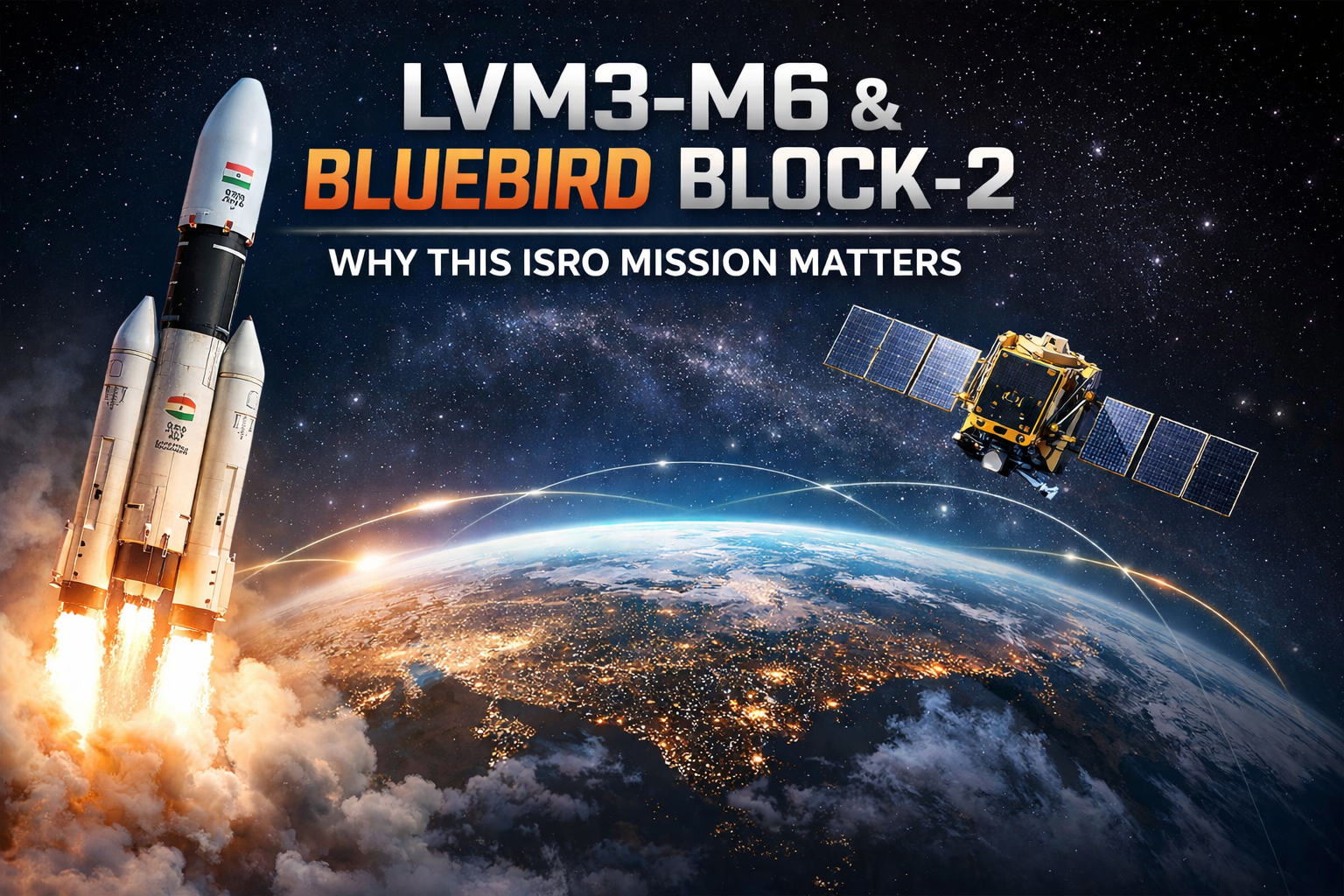
India’s space program rarely announces any launch, which means anything bigger than a mission. The preparation of ISRO’s heavy-lift launch vehicle LVM3-M6 to deliver Bluebird Block-2 to low Earth orbit (LEO) is one such moment.
On the surface, this appears to be another routine deployment. But when examined closely, the mission reflects profound changes in the future of India’s space strategy, global standing and orbital infrastructure.
This NewsWell Insight explains what LVM3-M6 represents today, why Bluebird Block-2 matters, and how this mission fits into the broader transformation of global space activity.
LVM3: From national capability to strategic asset
The Launch Vehicle Mark-3 (LVM3) was not always seen as India’s premier heavy-lift rocket. Early in its development, it was considered a long-term capability – necessary but experimental. That perception has changed decisively.
In several successful missions, LVM3 has demonstrated:
- consistent launch reliability
- Ability to carry heavy and complex payloads
- Adaptability to human-rated missions
- Operational maturity compared to global competitors
With each flight, the vehicle has transformed from a “proof of concept” to a strategic asset – on which India can depend for both domestic and international purposes.
Newswell Insight:
The real value of LVM3 lies not in individual launches, but in predictability. Reliability is more valuable than novelty in modern space missions. LVM3 is now working in that reliability-first area.
Why is LVM3-M6 operationally important?
The “M6” designation indicates more than a serial number. This reflects sustainability – an operational cadence that space agencies and commercial partners look for before committing high-value payloads.
Unlike earlier test-focused missions, LVM3-M6 demonstrates:
- A confidence-inspiring deployment
- minimal experimental risk
- Focus on mission execution, not verification
This change is subtle but important. Mature space programs do not declare rockets “ready“; They simply operate them. LVM3-M6 is firmly in that category.
Bluebird Block-2: Understanding the Role of Payload
While technical details of Bluebird Block-2 are limited in public disclosure, its classification and orbital destination provide important clues.
Why does low Earth orbit matter?
LEO is no longer just a convenient orbital zone – it is the center of gravity for modern space activity. Most of the next generation satellites are being deployed here for the following reasons:
- low latency for communication
- Easy servicing and upgrades
- Reduction in launch energy requirements
- Compatibility with Constellation-based architectures
Deploying a payload like Bluebird Block-2 into LEO puts it directly in the most strategically active region of space.
Newswell Insight:
The global space race is no longer about “who goes to the top”. It’s about who can operate at scale in LEO. Such missions indicate participation in that new reality.
The big picture: ISRO’s evolving mission profile
ISRO’s early reputation was built on cost efficiency and scientific ingenuity. Today, the agency is entering a new phase—operational relevance.
This development includes:
- Supporting advanced satellite systems
- Meeting international payload requirements
- Creating infrastructure for sustained orbital presence
- Aligning with commercial and strategic space demands
LVM3 is central to this transformation. Without a dependable heavy-lift platform, none of these ambitions are scalable.
Credibility as a strategic signal
In the global launch market, credibility sends a powerful message – often stronger than marketing or diplomacy.
Each successful LVM3 mission communicates:
- Engineering maturity
- Mission discipline
- Risk management capability
- Institutional confidence
These signals matter not only to governments but also to private satellite operators evaluating launch options.
Newswell Insight:
Today space partnerships are based not on slogans but on trust. Each stable launch quietly strengthens India’s negotiating position in future space cooperation.
India’s position in the global space ecosystem
The international space environment has changed dramatically over the past decade. Earlier dominated by a few state actors, it is now a mixed ecosystem:
- National space agencies
- Private launch provider
- Commercial satellite operator
- Defense Orbital Systems
India’s approach stands for its balance. It has:
- Avoid over-commercialization
- maintained state-led credibility
- Open controlled avenues for private participation
The LVM3-M6 fits well into this strategy – showcasing capability without pretension, showcasing strength without exaggeration.
What does this mission say about the future
In addition to the immediate deployment, LVM3-M6 hints at what’s coming next:
- More frequent heavy-lift launches
- complex multi-satellite missions
- Preparing for human space flight
- Expanded International Launch Services
The focus now is not on proving that India can launch heavy payloads. The focus is on how often and how reliably it can do this.
Newswell Insight:
The most important milestone for a space program is not its first success – but the moment when success becomes routine. LVM3-M6 suggests that India is approaching that limit.
Why does this matter beyond space enthusiasts?
Space missions often feel far removed from everyday concerns. But their implications ripple outward.
Reliable orbital access affects:
- Communication infrastructure
- Climate monitoring
- Navigation system
- Disaster response capabilities
- National security framework
Each successful launch strengthens the backbone of modern digital and strategic systems.
Conclusion: A Peaceful Breakthrough Mission
The LVM3-M6 may not dominate the headlines with a dramatic debut, but it arguably represents something more important – stability.
By preparing to place Bluebird Block-2 into low Earth orbit using a proven heavy-lift platform, ISRO is strengthening India’s role in:
- A confident astronaut nation
- A serious partner in the LEO economy
- Long-term contributor to global orbital infrastructure
At Newswell, we view this mission not as an isolated event, but as part of continued progress toward operational maturity. In the emerging space scenario, this could be India’s most valuable achievement so far.
Frequently Asked Questions (FAQ)
LVM3-M6 is the sixth operational mission of India’s heavy-lift launch vehicle Mark-3 (LVM3) developed by ISRO. It represents the mature, mission-ready stage of the rocket, focusing on reliable payload delivery rather than experimental testing.
LVM3 is designed to carry significantly heavier and more complex payloads than India’s earlier launch vehicles. It supports large satellites, advanced orbital missions and future human spaceflight programs, making it the cornerstone of India’s space infrastructure.
Bluebird Block-2 is a satellite payload to be deployed in low Earth orbit (LEO). Although detailed descriptions are not completely public, its classification and orbital destination indicate that it is part of advanced satellite operations focused on modern space-based applications.
LEO is the most active orbital sector today due to its advantages in communications speed, Earth observation accuracy, and cost efficiency. Many next-generation satellite systems operate in LEO, making it strategically important for both civilian and commercial space activities.
This mission is operational, not experimental. The LVM3-M6 reflects ISRO’s confidence in the reliability and performance of the launch vehicle, marking the transition from a verification mission to a regular deployment capability.
Read More : https://newswell.info/ram-mandir-expands-pilgrimage-capacity-ayodhya-spiritual-tourism/