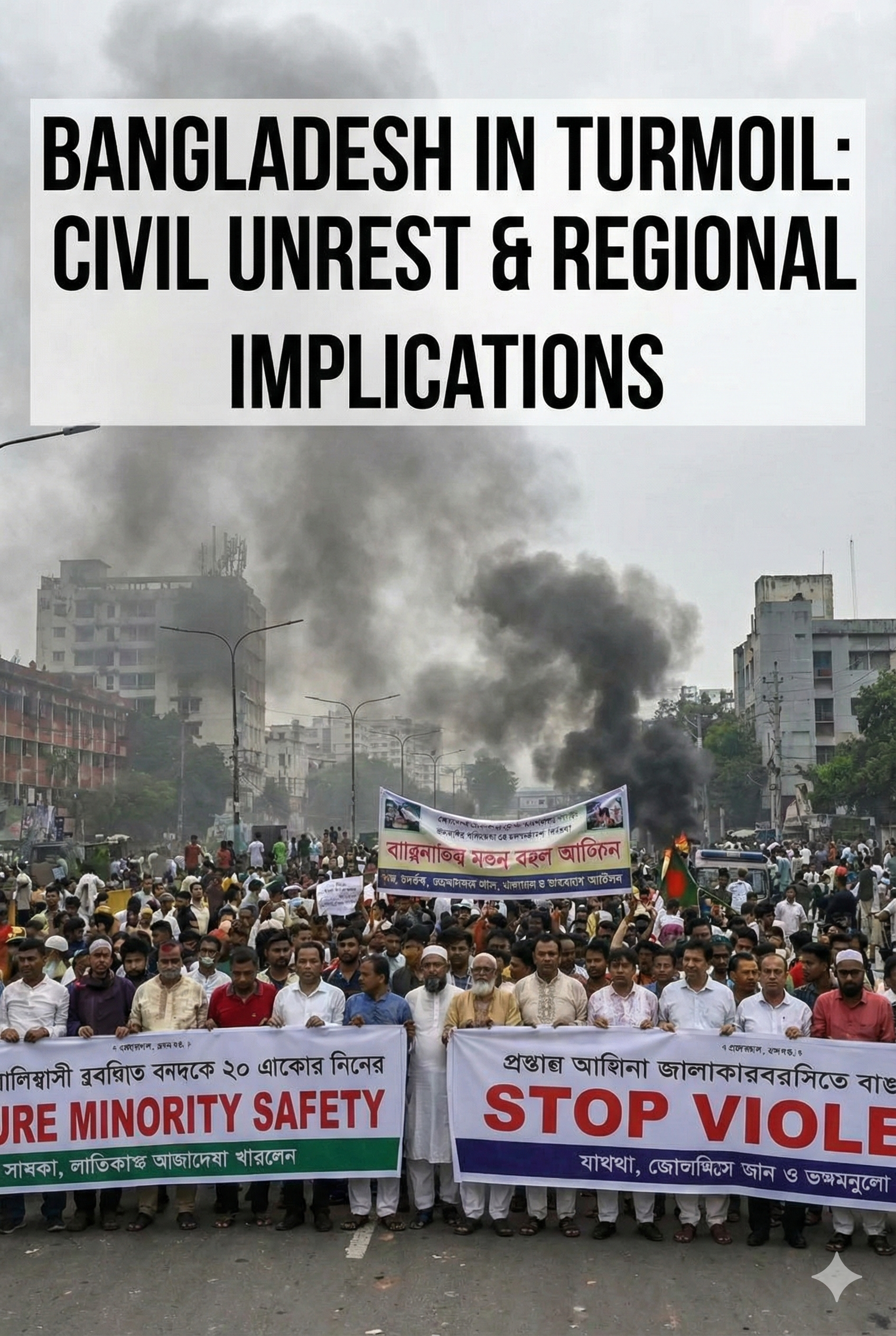
Bangladesh has entered a turbulent phase marked by political instability, street unrest and a series of violent incidents that have attracted national and international attention. In recent weeks, reports of arson, vandalism, mob violence and targeted threats have emerged from various parts of the country, raising urgent questions about public safety, minority security and regional stability. As the situation evolves, governments, human rights observers and diplomatic missions are closely monitoring developments that may have long-term implications for South Asia.
This analysis brings together verified reporting, broad context and careful assessment to explain what is happening, why it matters and what might happen next – without exaggeration or inflammatory framing. (Source : https://www.wionews.com/videos/bangladesh-violence-bangladesh-in-turmoil-after-uprising-leader-osman-hadi-dies-1766127873074)
Atmosphere of unrest
Periods of political change or intense polarization in Bangladesh have historically been accompanied by street protests and sporadic violence. The current phase does not differ in its intensity, but it is typical for the scale and frequency of incidents reported in urban and semi-urban areas.
Authorities have confirmed several cases of arson and vandalism affecting shops, vehicles and public property. In some areas, crowds gathered rapidly, overwhelming local police capacity and temporarily disrupting law and order. The Internet was slowed down in some areas and security measures were increased to prevent the spread of rumors.
While protests are not unusual in Bangladesh’s political landscape, observers believe the spread of unrest across districts and the speed at which it has turned violent remains a cause for concern.
Minority security is being investigated
The most serious aspect of the current unrest is its impact on minority communities, especially Hindus. Bangladesh is constitutionally secular, and minorities have long been an integral part of its social fabric. However, during periods of instability, minority neighborhoods have sometimes faced extreme vulnerability.
Human rights groups and local civil-society organizations have reported attacks on homes, shops, and places of worship as well as threats that force families to temporarily flee. Although not all reports are independently verifiable, there are enough credible accounts to generate concern and calls for protection.
In a widely reported incident, a Hindu man died during mob violence, sparking political condemnation and renewed demands for accountability. Officials have said that the investigation is ongoing. International observers stress that due process and transparent investigations are essential – not only for justice in individual cases, but also to restore public confidence.
Separating facts from misinformation
Social media has played a powerful role in shaping perceptions of the crisis. Images and videos – some authentic, some recycled from unrelated events – have circulated widely, often without context. This has spread anger and fear on both sides of the border.
Responsible reporting requires caution:
Verified facts include confirmed incidents of arson, vandalism and mob activity.
Partially verified claims include the scale and coordination of attacks in some districts, which remain under investigation.
Unverified or misleading content – including old footage presented as new – has increased tensions.
Media monitors stress the importance of cross-checking sources, relying on official statements and reputable outlets, and avoiding emotionally charged language that could escalate violence.
Diplomatic and regional dimensions
The unrest has also taken a regional dimension, particularly regarding relations with India. During the domestic turmoil, anti-India slogans and calls for an economic or cultural boycott have emerged in some protests. Analysts see these as strategies of political mobilization rather than indicators of mainstream public sentiment.
Nevertheless, such rhetoric has practical consequences. Indian diplomatic missions have reviewed security arrangements, and New Delhi has expressed concern for the security of its citizens and interests in Bangladesh. Stable India-Bangladesh relations are important for trade, border management, counter-terrorism cooperation and regional connectivity.
Any prolonged instability risks disrupting economic flows and undermining the trust built over years of bilateral engagement.
Role of governance and law enforcement
Restoring order depends largely on effective governance and impartial law enforcement. Security agencies face the dual challenge of preventing violence while respecting civil liberties. Strong responses can escalate tensions, while delayed action can embolden perpetrators.
Experts recommend a three-track approach:
- Immediate stabilization through targeted policing and protection of sensitive areas.
- Transparent investigation of reported murders, arson and attacks with clear communication to the public.
- De-escalation of political tensions, including dialogue with protest leaders and community representatives.
Without visible accountability, rumors flourish and trust erodes – creating the conditions for further
Humanitarian concerns and community impact
Beyond the headlines, the human cost of the unrest is significant. Displaced families also face temporary loss of income, disruption in schooling, and psychological trauma. Small businesses—often the backbone of local economies—suffer damage that may take years to repair.
Minority communities report a climate of fear, especially at night. Civil-society volunteers and local leaders have stepped in to provide assistance, but continued protection requires state action.
International humanitarian principles emphasize that minority protection is not a political issue; This is the fundamental responsibility of the state. Protecting vulnerable citizens during unrest strengthens national unity rather than weakening it.
International response and monitoring
Global attention has intensified as news of the violence spread. International human rights organizations have urged Bangladesh to uphold its commitments under international law, ensure freedom of religion, and protect civilians.
Foreign governments have largely adopted a restrained tone and called for peace, restraint and the rule of law. This reflects a desire to avoid provoking domestic politics while indicating that the situation is being monitored closely.
Such scrutiny can be constructive if it encourages reforms and accountability – but it can be counterproductive if it is viewed as outside interference. Balancing sovereignty with universal human rights norms remains a delicate task.
What comes next?
Several scenarios are possible in the coming weeks:
De-escalation: If authorities restore order, investigate incidents transparently and reassure communities, tensions can gradually subside.
Local flare-ups: Sporadic violence may persist in some areas, especially if misinformation spreads unchecked.
Prolonged instability: Failure to address root causes could lead to repeated unrest, economic disruption, and diplomatic tensions.
The outcome will depend on leadership decisions, institutional capacity, and the willingness of political actors to prioritize sustainability over short-term gains.
Why does this matter beyond Bangladesh?
Bangladesh stands at a strategic crossroads in South Asia. Instability there affects regional trade routes, migration patterns and security dynamics. For neighboring countries, especially India, continued unrest complicates border management and economic cooperation.
On a broader level, the crisis underscores a universal lesson: Political instability often exposes social fault lines, and minorities are often the first to bear its costs. Dealing with such crises requires restraint, responsibility and a commitment to facts over hysteria.
Conclusion
Bangladesh’s current turmoil is a complex mix of political tensions, social vulnerabilities and regional influences. Verified reports of arson, mob violence and the murder of a Hindu man have drawn attention to urgent concerns about law and order and minority safety. At the same time, misinformation risks inflaming emotions and obscuring the path to resolution.
The way forward lies in transparent governance, protection of all citizens and responsible communication by officials, media and the public. As developments continue, careful analysis and verified reporting will be essential to understanding not just what is happening, but what it means for Bangladesh and the wider region.
Frequently Asked Questions (FAQs)
The protests, initially sparked by political tensions and the death of a youth leader, have escalated into widespread unrest. In this charged environment, marginalized groups—particularly Hindu communities—have faced disproportionate risks from mob violence and rumors fueling local attacks.
Historical grievances around political representation, economic inequalities, and under-resourced law enforcement in minority areas have increased the risks, leaving religious and ethnic minorities more exposed if civil order breaks down.
Social networks have exaggerated real events and misinformation alike, increasing fear and distrust. Misleading videos and unverified claims can spread faster than official explanations, complicating efforts to defuse tensions.
Neighboring countries, particularly India, have publicly expressed concern about violence against minorities and demanded accountability. This external investigation puts diplomatic pressure on Dhaka to investigate and protect vulnerable communities, affecting bilateral relations.
Read More : https://newswell.info/ahmedabad-school-bomb-threats-explained/