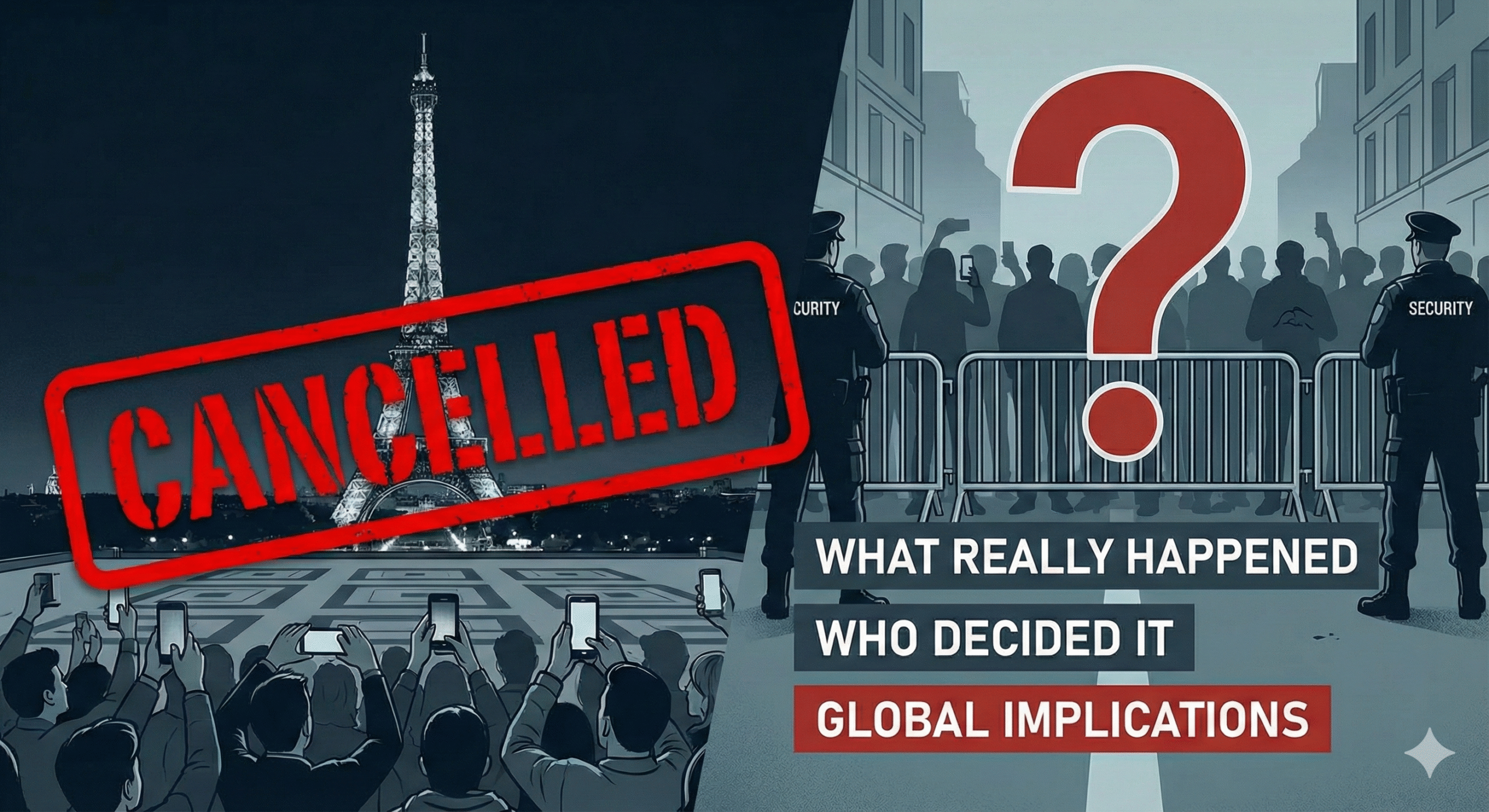
Paris New Year’s Eve Fireworks Cancelled: What Really Happened, Who Decided It, and What It Means for Global Celebrations
Paris has long been a symbol of romance, luxury and grand public celebrations. Every New Year’s Eve, millions of people gather on the Champs-Élysées, beneath the Eiffel Tower and in the city’s historic squares to welcome the year with fireworks that are broadcast around the world.
But this year, something unprecedented happened:
New Year’s Eve fireworks in Paris were canceled.
The announcement stunned tourists, confused locals, and immediately sparked a global conversation.
Searches for “Paris fireworks cancelled”, “Paris New Year fireworks 2025”, and “why did Paris cancel New Year fireworks” increased overnight.
Beyond the disappointment, the decision has raised deep questions about safety, crowd management and the future of large-scale public gatherings in major global cities.
This analysis from NewsWell explains what we know, why the decision matters, and what’s next for Paris and Europe. A silent new year in the city of lights On New Year’s Eve, Paris usually prepares for millions of visitors.
Hotels are sold out, transportation is running at peak capacity, and officials are deploying sweeping public safety measures. This year was no different – until the final announcement confirmed there would be zero fireworks in Paris.
For tourists who had traveled specifically for the iconic midnight performance, the cancellation felt sudden. It had a mixed reaction among locals – some relieved by the focus on safety, others worried about cultural and economic impacts. Hashtags related to Paris New Year celebrations, Eiffel Tower fireworks and Europe New Year events began trending globally, causing social platforms to quickly fill up with reactions.
The absence of fireworks was not merely a cultural loss – it was symbolic. Paris is a city that has historically chosen to celebrate even after tragedy.
When Paris goes quiet, the world notices.
Why were Paris New Year fireworks cancelled?
Officials did not give a single reason, but several factors came together to influence the final decision.
According to officials and analysts, the cancellation was based on a risk assessment rather than a reaction.
1. Safety concerns in high density crowds Large public gatherings remain one of the most complex challenges to urban security. With millions of people expected to converge on confined areas, it becomes increasingly difficult to manage crowd flow, emergency response and threat mitigation. In recent years, European capitals have recalibrated their approach to mass events.
The emphasis has shifted from visibility to vulnerability – asking not how prestigious an event looks, but how exposed it is. In this context, Paris security concerns played a central role.
2. Congestion control and infrastructure stress Paris already faces regular stress during peak tourist periods. Transport networks, emergency services and law enforcement have been pushed to their limits.
A single disruption – weather, panic, or misinformation – can escalate rapidly. Authorities reportedly evaluated crowd control risks, particularly around transit centers and pedestrian areas. The concern was not just deliberate threats, but unintentional chaos.
3. Preventive governance over reactive policing One of the most obvious signs from this decision is a change in mindset. Rather than preparing to respond after an incident, officials are prioritizing preventive governance – reducing risk by limiting exposure. This approach is in line with broader European trends in public event security, where cancellations are no longer seen as a failure, but as a precaution. Tourists were surprised, locals were divided and the public reaction was not uniform.
Tourists expressed disappointment, especially first-time visitors to Paris.
Many people had booked months in advance in anticipation of the traditional performance. The local residents were divided.
Some welcomed the quiet night and the priority given to safety. Others are concerned about the economic impact on hospitality, transportation and small businesses.
This divide reflects the broader tension facing global cities:
- balancing economic
- Tourism dependence with urban security realities.
From a Newswell perspective, this moment highlights a key insight: Modern cities are being forced to choose between spectacle and sustainability. Is this the new normal for global cities? Perhaps the most important question raised by the cancellation is not just about Paris, but about the future of global festivals.
Cities like London, New York, Berlin and Tokyo face similar pressures – dense populations, complex security environments and global scrutiny. If Paris, one of the world’s most experienced hosts of mass events, exercises caution, it sets a precedent. Search trends already reflect this shift, with growing interest in: “New Year’s Fireworks Safety Europe” “Global Cities Festival Cancelled”
“The future of public events in major cities” The implication is clear: large-scale celebrations could be more controlled, decentralized or symbolic rather than explosive.
Who made the decision?
Decisions of this magnitude are rarely taken by a single authority. In Paris, such calls typically involve coordination between: city administration,
national security agencies and emergency services transport authority.
What matters more than the names involved is the process:
multi-layered risk assessment rather than political optics.
It reflects the governance model increasingly seen across Europe – quiet decisions that prioritize security over spectacle.
What does this mean for Europe?
Paris often serves as a cultural barometer for Europe. When Paris changes course, other cities pay attention.
The cancellation could impact how future events are planned across the continent: Increasing use of controlled-entry ceremonies More digital or broadcast-focused programs More emphasis on localized celebrations rather than single mass gatherings From a Newswell Insights perspective, this signals a broader reconfiguration of urban public life in a post-risk era.
Economic and cultural impact Although safety comes first, the economic implications cannot be ignored.
New Year’s Eve is a major revenue driver for:
- Hotel
- Restaurant
- Transport operator
- Event Services
A subdued celebration not only impacts revenues but also impacts global perception. Paris has long promoted itself as a city that celebrates openly and collectively. Any deviation from that image will have branding consequences. However, there is another angle: trust. Cities that demonstrate proactive safety measures can strengthen long-term trust among visitors, even if there are short-term disappointments.
NewsWell Insight:
It Wasn’t About Fear—It Was About Control At Newswell, we see this decision not as a sign of weakness, but as evidence of improved urban governance.
The key insight is this: The cancellation of New Year’s Eve fireworks in Paris reflects a shift from a reactive celebration to a controlled experience. It’s not about canceling out the pleasure. It’s about redefining how happiness is delivered in a world where risk increases at scale.
The future of global gatherings may be calmer, more distributed, and more deliberate – but also safer and more flexible.
What comes next for Paris?
Paris is unlikely to abandon public gatherings entirely. Instead, expect: small, distributed programs Increased use of light shows, projections and digital experiences Overdependence on broadcast and streaming audiences The city has reinvented itself several times throughout history. This moment may mark another change – one shaped not by fear, but by foresight.
Final thoughts: The cancellation of New Year’s Eve fireworks in Paris is more than a headline. It is a case study in how modern cities juggle security, symbolism and public expectations.
As global audiences ask “What really happened?” And “What’s next for Paris?”, the deeper question remains: How will cities celebrate together in an increasingly complex world? For full updates, verified facts and editorial insights on global events shaping our future, visit Newswell.info
For More Interesting Read this : https://newswell.info/bondi-beach-terror-attack-australia-analysis/